What Ivy League Admissions Officers Read Before Your Essay
October 19, 2026

Quick Summary
Getting into an Ivy League school starts long before you write your personal essay. Admissions officers often make their first critical judgments before they read a single word of your writing. At many schools, those initial moments focus entirely on your academic record, and an early academic screen can remove many applicants before essays are reached. The transcript, school profile, and test scores help determine whether an officer will invest in your full file or flag you as an unlikely admit.
What Gets Read Before Your Essays
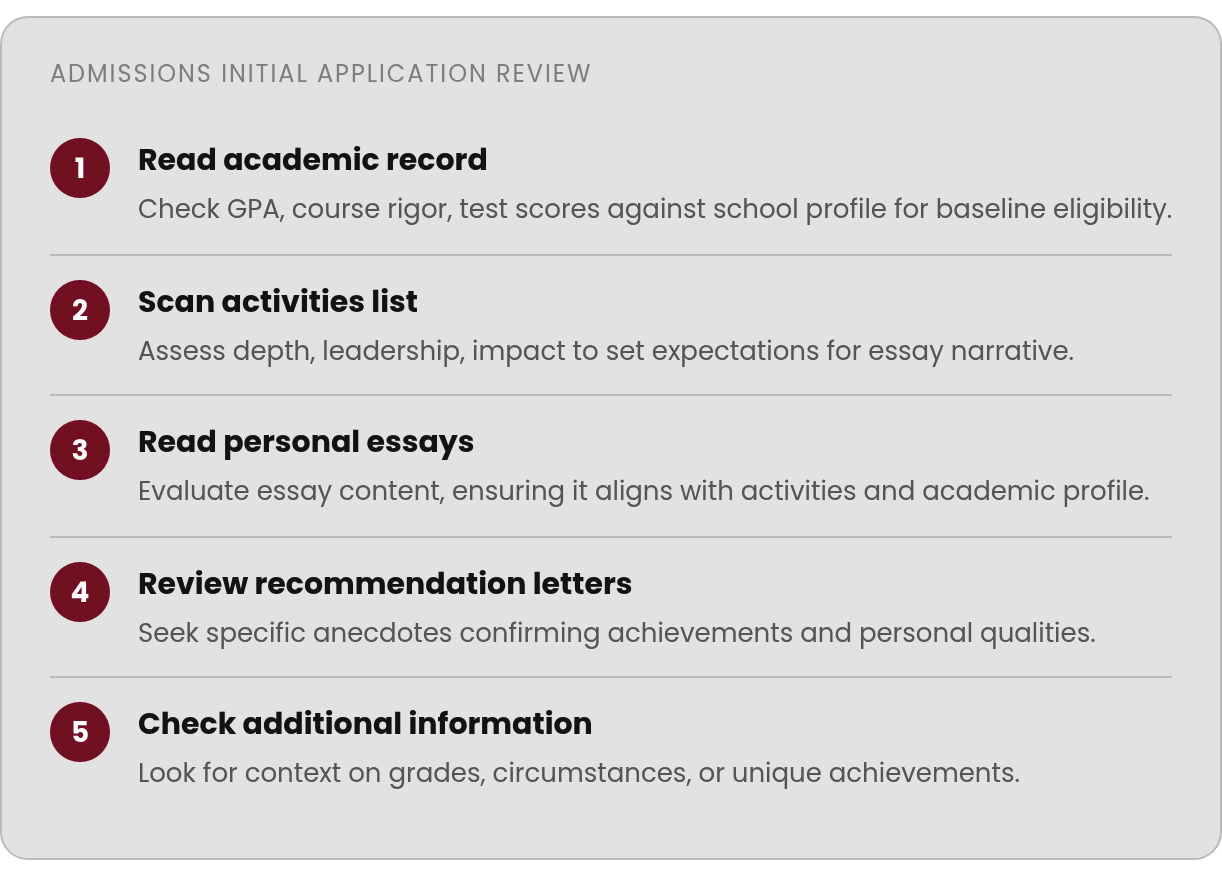
Many officers follow an approximate sequence during the initial read, but schools and readers differ, and some cross-reference components as they go. Usually, the academic index comes first: they check your GPA against your school's profile, review course rigor, and glance at test scores. A 3.8 GPA at a school where top students average 3.7 signals strength. The same 3.8 at a school where most applicants carry above 3.9 raises concerns.
Your activities list gets read second, before the personal essay. An experienced reader identifies whether you've built depth in one area or padded your résumé with surface-level commitments. This list sets expectations: if it shows environmental science research, a nonprofit, and published work, the officer expects your essay to deepen that story. An essay about an unrelated topic fractures the narrative.
Only after this early review do officers turn to your personal statement and supplemental essays. Recommendation letters come next, followed by a scan of additional information for context on grade drops or family circumstances.
How Rating Systems Shape Your File
Harvard assigns scores in six components—academic, extracurricular, athletic, personal, recommendation, and overall—using a 1–6 scale where 1 is best. Your overall score skews toward your strengths rather than averaging all components. A 6 in athletics won't sink you if academics and extracurriculars both earn 1s.
The academic rating reveals a crucial threshold. Near-perfect scores and grades alone earn a 2, not a 1. To reach the top tier, you need "unusual creativity and possible evidence of original scholarship"—for example, independent work that shows intellectual initiative beyond test scores. At UPenn, nearly one-third of admitted students in the Class of 2026 had conducted independent research.
Officers aren't subject experts in your intended major. Many are generalists by training, not quantum physics or bioengineering. Your application must translate specialized work into clear impact rather than technical jargon.
Practical Steps to Align Your Full Package
Request recommendation letters early—by spring of junior year—so teachers have time to write specific stories rather than generic praise. "She submitted a revised draft without being asked" carries weight; "She is a joy to teach" does not.
Finalize your activity descriptions before you draft essays. Each entry is short. Officers look for leadership, measurable outcomes, and depth over three years, not a laundry list of fifteen clubs. One organization where you built something real beats surface-level participation everywhere.
Confirm test-score policies before submission. Testing requirements shift from year to year, so check each school's admissions website for the most current policy. Once testing has demonstrated readiness, additional points matter less than substantive intellectual work.
Check your transcript for accuracy months before application deadlines. Errors happen, and fixing them takes time. Make sure your school profile clearly lists how many AP/IB courses are available—officers use this to assess whether you took the most rigorous path.
Key Takeaways
- Admissions officers examine the academic record before the essays, and the opening review can eliminate a substantial share of applicants.
- Harvard's rating system assigns scores on a 1–6 scale where a "1" reflects the strongest evaluation, while perfect grades alone earn only a "2."
- Activities lists come before the personal statement and establish the expectations an essay must meet.
- Independent research and other evidence of original scholarship can distinguish an academically excellent applicant from one who reaches the highest rating tier.
Why the First Read Controls Everything That Follows
We work with families who spend months perfecting a personal essay while barely thinking about what gets read before an officer reaches it. That first-read stage—the scan of your transcript, school profile, and test scores—sets the frame for everything that follows. A file that reads cleanly in the opening pass gives the officer a reason to search for strengths. A file that raises questions makes the reader look for missing context. At many selective colleges, the first reader also drafts the summary that travels with your file into committee, so the initial impression continues to influence discussion after the essay has been read.

How Early Materials Shape Attention
The materials officers review before your essay create context for everything that follows. Here is the component review we use:
- Transcript: proves readiness and rigor; readers cross-reference your GPA with the school profile to understand course availability, grading practices, and how far you pushed.
- Activities: prove depth, leadership, and measurable outcomes; the list previews the narrative your essay should reinforce.
- Recommendations: prove specific classroom impact; generic praise does not move the reader.
- Context/additional information: explains genuine anomalies like grade drops or limited AP offerings—not a single B or résumé padding.
- Essay: adds voice and self-awareness; it deepens a narrative already taking shape rather than creating one from scratch.
Admissions officers evaluate applicants holistically. They look beyond raw qualifications to understand each student's contribution. Your academic record establishes preparation. Activities and recommendations show what you've built and how teachers describe your classroom presence. The essay adds voice and self-awareness, but it reinforces a narrative already taking shape.
Why Families Overweight the Essay
The misconception persists because the essay feels like the most personal, controllable element. You can revise a 650-word statement repeatedly; you can't retroactively add an advanced course or change a recommendation. But officers are looking for coherence across the full file, not isolated brilliance in one component.
We often see students spend weeks perfecting an essay while submitting a vague activities list or failing to brief recommenders on specific classroom moments. The result is a file where the essay stands alone rather than reinforcing a narrative that began with the academic record and activities. When the earlier materials are strong, the essay has room to add depth instead of carrying the entire argument.
Strong applications build coherence across every component—coursework, extracurriculars, essays, and achievements that point toward a clear academic identity. If your activities show leadership in debate and policy research, your recommendations should validate your analytical thinking in class discussions, and your essay should reveal the experiences that shaped your interest in civic engagement. Alignment lets officers spend less time puzzling over who you are and more time advocating for you in committee.
What Officers Actually Review First
Applications do not always move through officers' hands in one fixed sequence, but understanding the pattern can change how families invest their energy. At many schools, the academic record gets read first—not your essay, not your activities list. Officers assess your GPA, course rigor, and test scores before deciding whether to keep reading. At highly selective schools, that initial judgment occurs in a pool where many applicants already meet the academic baseline, so the transcript must demonstrate both readiness and ambition.
Your Transcript Sets the Gate
Officers check whether your GPA clears the school's threshold and whether you took the hardest courses available at your high school. The school profile—the document your counselor submits—gives officers the context they need to interpret your grades. They're not just looking at the number. They're checking how far you pushed within your school's offerings.
Test scores still matter at schools that require them. Once testing has demonstrated readiness, additional points matter less than substantive intellectual work.
Activities Get Read Before Your Essay
Your activities list is the second stop, not the fifth. Officers scan your entries to answer a specific question: does this student have a spike? They're checking for depth in one area, not breadth across many clubs. The list sets expectations for what the essay should reinforce. If your activities show deep commitment to environmental science—research, a nonprofit, published work—the officer expects your story to engage that commitment. An unrelated topic can make the application feel disconnected.
Impact beats participation. Officers aren't looking for generic volunteering or a long list of memberships. They want to see what you built, what changed because of your work, and whether external groups validated your contributions. Research experience, meaningful projects, and leadership roles that demonstrate initiative all help distinguish your profile. Each short activity description previews the narrative your essay will expand.
Recommendation Letters Confirm What You've Shown
Officers read your teacher and counselor recommendations after your essay, not before. They're looking for third-party validation and specific stories that the rest of your file can't provide. A letter that only confirms you worked hard and earned an A won't help much. The strongest letters describe specific moments: "She submitted a revised draft without being asked, incorporating three new sources she found independently." Generic praise—"a joy to teach"—disappears in a stack of applications.
Counselor letters carry weight when they explain anomalies the transcript can't show. A grade dip during a family crisis, limited AP offerings at your school, or responsibilities that pulled you out of school all belong in the additional information section and the counselor's letter. Use that section only for context that genuinely matters; it is not a place to explain a single B or pad your résumé with minor awards.
How Your Personal Qualities Get Evaluated Before You Write a Word
We form an initial impression of your personal qualities before we open your essay. That impression shapes how we interpret the story you're about to tell. The activities list, recommendation letters, and contextual signals contribute to what admissions committees call a personal rating or non-academic assessment. Harvard's process assigns this rating on a 1–6 scale. It reflects what kind of effect you might have on others at the university and beyond, drawing on teacher comments, counselor observations, and the pattern of choices visible in your activities.
Your essay enters a conversation already underway. A record of environmental advocacy, recommendations describing independent research habits, and a counselor's account of resilience through family hardship have already introduced important themes. The essay can deepen them. The strongest applications create a through-line. Each component reinforces the same core identity.
The Rating Systems That Quantify Your Story Before the Essay
Some schools evaluate applicants across multiple dimensions, including academic, extracurricular, and personal qualities, with readers producing separate scores that inform committee discussion. Trained evaluations translate qualitative information—a teacher's description of revision habits or a counselor's account of leadership during a crisis—into a framework the committee can discuss.
Characteristics valued in these ratings aren't always synonymous with extroversion. Being reflective, insightful, and deeply committed to a narrow focus can yield a stronger personal assessment than being loud in every room. A former Wharton admissions director noted that officers flag inconsistencies such as an essay leaning heavily on an activity ranked seventh on your list. If it shaped you that profoundly, the reader may wonder why the ranking does not show it.
The rating assigned before your essay sets expectations. Officers enter your personal statement already knowing whether your recommendations portray you as intellectually curious, collaborative, or resilient under pressure. Your writing should make those qualities credible and add dimensions that the rest of the file could not show.
What Activities and Recommendations Actually Signal
Your school profile matters here too. Regional readers develop familiarity with the schools in their territory, so claims in your recommendations get considered alongside what the reader knows about your school's standards and opportunities. Concise, credible evidence is especially valuable.
How Institutional Priorities and Context Shape the Pre-Essay View
Your application also gets evaluated against organizational needs—what research on selective admissions calls the "competition perspective," not the pure "merit perspective." Interviews with 34 admissions officers at 17 elite colleges revealed that committees balance individual achievement against what the incoming class still needs: a cellist, a debate champion, geographic diversity, or a student who overcame significant hardship.
Recruited athletes, legacy applicants, and institutional priorities enter the frame here. Ivy League recruited athletes must meet minimum academic standards, but their non-academic ratings carry different weight in committee discussion. Princeton's process explicitly includes an institutional-priority rating alongside academic and non-academic scores, flagging applicants who fill specific needs for the class.
For students without those hooks, the pre-essay impression hinges on whether activities, recommendations, and context show a distinctive contribution. Admitted students at highly selective schools typically demonstrate initiative beyond classroom requirements. They found organizations, build projects outside formal structures, or pursue questions that do not fit neatly into existing programs. Externally validated accomplishments can signal that commitment before the essay explains it.
Where This Leaves You
Your essay doesn't create your story. It articulates a story already visible in the rest of your file. Before the essay, the question is whether your narrative is coherent, differentiated, and aligned with class needs. For more on building that coherence across every component, see how a story strategy shapes your full application.
References
[1] How Admissions Officers Read Your Application: 8-Minute Review - https://orieladmissions.com/how-admissions-officers-read-application-8-minute-review/
[2] 12 things Ivy League admissions officers actually look at (and 3 that ... - https://riseglobaleducation.com/blogs/what-ivy-league-admissions-officers-actually-look-at
[3] How Ivy League Admissions Officers Rate Your Application - https://www.collegeadvisor.com/resources/ivy-league-application/
[4] How Admissions Officers Evaluate College Applications - YouTube - https://www.youtube.com/watch?v=U31nutkm1DM
[5] What Ivy Admissions Officers Look for When Reading College Applications - https://toptieradmissions.com/what-ivy-admissions-officers-look-for-college-applications/
[6] How Long Do Admission Officers Spend on Each Application? - https://www.ivycoach.com/the-ivy-coach-blog/college-admissions/8-minute-rule-college-admissions/
[7] How Colleges Read Your Application: A 4 Step Process | PrepMaven - https://prepmaven.com/blog/applying/how-colleges-read-your-application-a-4-step-process/
[8] How Selective Colleges Review Applications - https://www.collegeessayguy.com/blog/how-selective-colleges-review-applications
[9] Institutional Expectations and Students' Responses to the ... - https://www.researchgate.net/publication/328467352_Institutional_Expectations_and_Students%27_Responses_to_the_College_Application_Essay
[10] Merit and Competition in Selective College Admissions - https://www.researchgate.net/publication/236704765_Merit_and_Competition_in_Selective_College_Admissions
[11] Institutional Expectations and Students' Responses to the ... - https://www.researchgate.net/journal/Social-Sciences-2076-0760/publication/328467352_Institutional_Expectations_and_Students%27_Responses_to_the_College_Application_Essay/links/681e32a1bd3f1930dd6f1151/Institutional-Expectations-and-Students-Responses-to-the-College-Application-Essay.pdf
[12] Translating Authentic Selves into Authentic Applications - https://www.researchgate.net/publication/375103215_Translating_Authentic_Selves_into_Authentic_Applications_Private_College_Consulting_and_Selective_College_Admissions
[13] Holistic Admissions in Higher Education: Challenges and Promise - https://www.researchgate.net/publication/362162300_Holistic_Admissions_in_Higher_Education_Challenges_and_Promise
Still Wondering?
1. If my activities list shows environmental science but my essay topic is about playing piano, will that hurt my application?
It may raise questions about emphasis and identity. If environmental science dominates your activities—research, nonprofit work, and field studies—but the essay focuses on a lower-ranked pursuit, officers may see a disconnect. That does not automatically make the essay unacceptable, especially if the piano story reveals a meaningful dimension absent elsewhere. Explain why the experience matters and connect it, where natural, to the qualities visible across the rest of the application.
2. Can a perfect 4.0 GPA and 36 ACT alone earn Harvard's top academic rating of “1”?
No. Near-perfect scores and grades typically earn a rating of “2” at Harvard, not “1.” The top academic tier requires evidence of unusual creativity or original scholarship. Once testing has demonstrated readiness, additional points matter less than substantive intellectual work.