What Ivy League Admissions Officers Read First in Your Application
October 25, 2026

A student with a 4.0 GPA and a 36 on the ACT may think the hard part is over. We see that often. In practice, the first read has two stages: academics and testing establish readiness, then narrative coherence determines distinction. Understanding how to get into Ivy League schools takes more than clearing academic thresholds. Admissions committees still need evidence that your coursework, commitments, character, and recommendations point in the same direction.
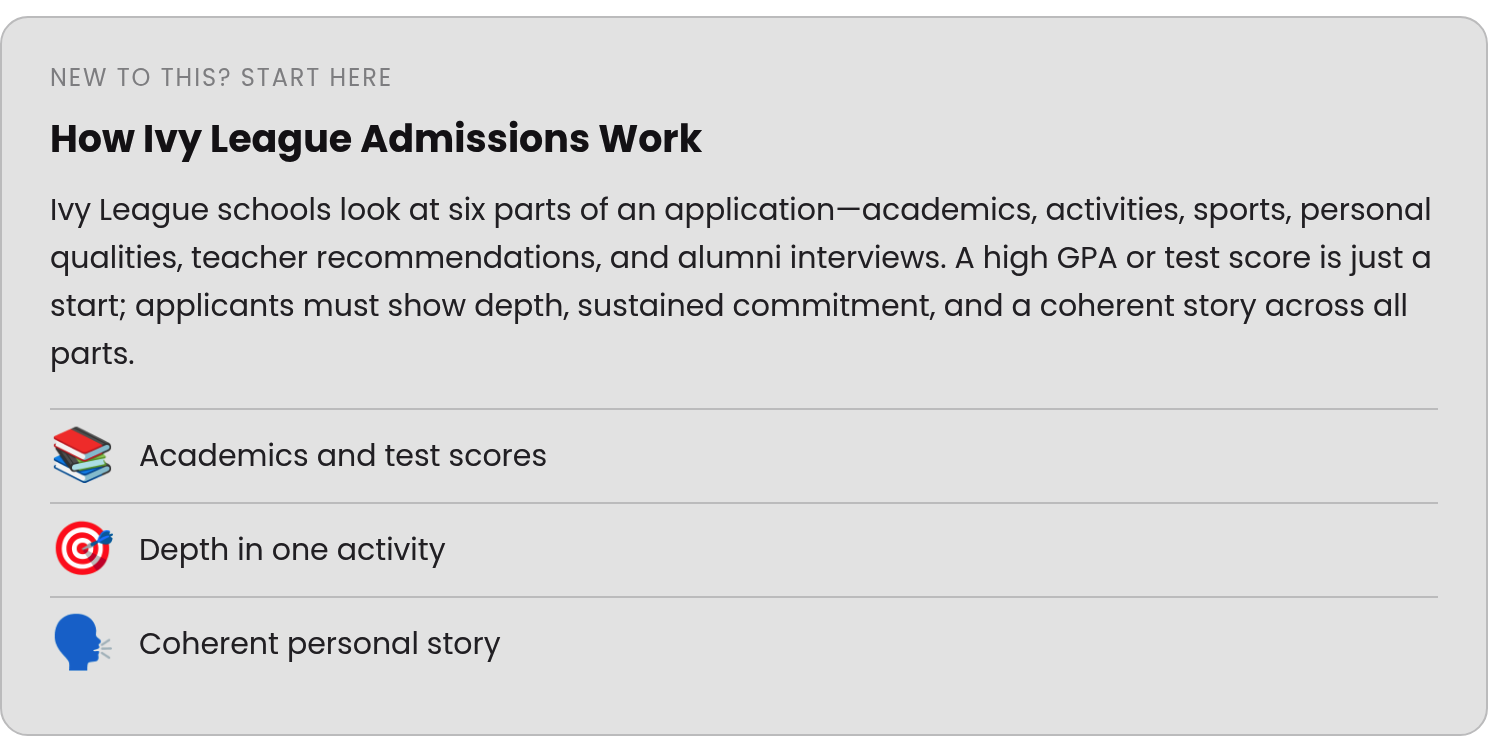
Harvard’s reported 1–6 rating system evaluates six parts of an application: academics, extracurriculars, athletics, personal qualities, teacher recommendations, and alumni interviews. A 1 is the strongest rating; a 6 is the weakest. These ratings do not combine into a simple average. A strength in one area can support your candidacy, but it cannot compensate for every weakness. Harvard’s published reading procedures, summarized in this analysis of the six-part evaluation, offer a useful framework for understanding that distinction.
| Component | Harvard Rating Relevance | Evidence-Based Benchmark or Consideration | Quick Tip |
|---|---|---|---|
| Academics | Often carries exceptional scrutiny | Near-perfect grades and scores alone may still produce a 2; the highest rating also calls for unusual creativity or original scholarship | Build a three-part record: strong performance, rigorous coursework, and sustained intellectual direction |
| Extracurriculars | Often receives exceptional scrutiny | A strong extracurricular record can support the broader academic evaluation, but accomplishments should show depth and sustained commitment | Lead one meaningful project and show responsibility, commitment, and community impact |
| Athletics | Can strengthen a relevant application | A low rating generally will not drag down an otherwise strong file | Skip recruiting strategy if you do not compete; focus on the qualities your file already demonstrates |
| Personal qualities | Helps reveal character beyond achievements | Strong applicants still need a coherent account of contribution, empathy, and purpose | Connect service and interests to a sustained theme rather than unrelated credentials |
| Teacher recommendations | Add external evidence of character and work | Recommendations should reinforce, not repeat, the application’s central narrative | Ask teachers who can speak to specific examples of collaboration, curiosity, and growth |
| Alumni interviews | Contribute context, but generally carry less weight | A thoughtful interview can clarify your interests and fit | Prepare specific reasons for your interests and discuss how the opportunity would extend them |
One apparent contradiction deserves attention. Harvard’s framework gives academics and extracurriculars particular weight, while former Yale admissions officer Eddy C. describes grades and testing as basic requirements among top candidates, according to this Ivy League admissions guide. Both views can hold: metrics establish readiness, and coherent evidence determines distinction among highly competitive applicants.
Why first-read items matter
Ivy League admissions are exacting, and the first read tests both stages. Academic metrics establish readiness. Then coherence—evident in academic direction, meaningful commitments, and support from people who know you well—determines whether the file becomes distinctive. Your application should not read like a pile of disconnected assignments.
Harvard’s evaluation framework maps onto the two reads: preparedness and challenge appear in academics and testing; direction appears in sustained coursework and activities; contribution appears in activities, recommendations, and personal qualities. Reviewers consider the application as a whole rather than averaging every element in the same way. A strong academic and extracurricular record can strengthen a file, but a weaker area still needs context. Athletics also function differently for recruited athletes than for applicants whose participation does not align with an institution’s evaluation priorities.
How do you make every part of your application coherent?
Begin with the readiness stage: strong grades and test scores can establish preparedness, while rigorous coursework and thoughtful planning show challenge and connect your studies with your interests and possible fields of study. Our customized planning process accounts for each student’s strengths, goals, and experiences rather than treating every path as interchangeable.
Then show the direction and contribution stage: a sustained commitment with meaningful responsibility can tell a stronger story than a crowded list of activities. Essays, recommendations, and the alumni interview should add evidence, not repeat information already presented elsewhere. Specific examples of curiosity, collaboration, and growth give the file credibility.
One judgment guides our work: do not optimize every section for a perfect score separately. Optimize for a coherent, credible account. A reader should be able to follow the same priorities through your transcript, activities, essays, and recommendations.
The application overview page
Treat the overview as an accurate gateway to the full file, not as a decisive page. Check every name, school title, course title, GPA format, and intended academic direction against your records. Accurate information prevents confusion. It cannot manufacture a stronger record.
The overview supports the six-component review
The Harvard rating analysis shows that reviewers weigh academic preparation alongside the context of an applicant’s opportunities. The overview is not a standalone verdict. Other parts of the file can change how a reader interprets an individual grade, activity, or accomplishment.
In our application mentorship, we help students check that their academic history, activities, recommendations, and personal story present a coherent picture. This panel-based review draws on several perspectives, helping the main parts of the application support one credible direction. An Ivy admissions guide also explains that reviewers assess rigor within the applicant’s school context, which makes raw GPA only one measure of readiness.
A practical accuracy protocol
Before submitting, confirm that every displayed detail matches your transcripts and school records. Use consistent formats for GPA and test scores, name your intended major accurately, and ask someone unfamiliar with your application to flag confusing entries. Correct every verifiable error, remove clutter, and move on; the overview should help reviewers locate your evidence, not manufacture it.
Academic metrics: GPA, course rigor, and test scores
A 4.0 GPA and a 36 on the ACT can establish competitive readiness, but they still may not demonstrate the exceptional intellectual work the highest academic rating requires. That is the limit of strong metrics at Ivy League schools: grades and scores answer readiness, not distinction.
Academic ratings reveal the ceiling
Harvard’s published reading procedures assign applicants ratings from 1 to 6 across several parts of the application. Within the academic category, a rating of 1 requires near-perfect grades and test scores plus “unusual creativity and possible evidence of original scholarship,” as this explanation of Harvard’s rating system describes. A strong GPA alone may therefore be insufficient for the highest academic rating.
That creates a useful tension within the file. Grades and scores establish the academic foundation, while the rest of the application shows how you have used that preparation. We treat the transcript as evidence of readiness, then connect it to the intellectual direction shown through commitments, writing, and recommendations.
Rigor and scores answer different questions
The available evidence does not provide a general Ivy League formula for weighing GPA against course rigor. It does encourage a closer look at whether you pursued the most substantial learning available at your school: advanced courses when appropriate, challenging material, and academic growth. Test scores answer a narrower question; they provide one measure of preparation, but no score can replace the broader academic record. In our experience, the strongest files connect achievement, challenge, and direction: rigorous coursework, competitive scores, and choices connected to the academic story your application tells.
The personal narrative: main essay
A student can have a compelling résumé and still submit an essay that feels disconnected from it. This is where many families struggle with Ivy League applications. In the two-stage read, the personal essay does not need to repeat every accomplishment. It shows how your experiences shape your character, interests, and goals.
How can your essay strengthen your application?
The essay gives readers a view of how you think, what you value, and how you respond when a plan changes. It can provide context for personal qualities that grades and activity titles cannot show. It contributes to the coherence read rather than repeating the readiness metrics.
The tension here is useful. Harvard’s top academic rating calls for more than high marks, including creativity or original scholarship. At the same time, former Yale admissions officer Eddy C. describes academics and testing as basic requirements among the most competitive applicants, who are often distinguished by how they communicate their own successes and contributions. Our advice is to treat strong metrics as your entry point, then use the essay to establish coherent direction, according to this Ivy League admissions guide.
What should you write about?
Choose one experience and show three things:
- A specific moment: What happened, and what did you do?
- Your reasoning: What did you notice, question, or reconsider?
- The lesson: How did the experience shape your values or goals?
Rather than describing a robotics competition in broad terms, explain the design failure that forced you to change methods. Avoid claiming that a routine activity transformed your life. If it did not, show a smaller but genuine change in perspective.
Finally, compare the essay with your academic record, activities, recommendations, and intended field. The details do not need to match exactly, but they should support one credible account of who you are. Skip claims that admissions officers always read an opening line first; we have no reliable evidence for that. Focus on specificity, reflection, and alignment instead.
Supplemental essays and fit statements
A student can write two responses with equally polished prose and have only one feel convincing. The difference usually lies in school-specific reflection, not word count or a memorable opening. In the coherence stage, that distinction matters in Ivy League admissions through supplemental essays.
How should you tailor a school-specific response?
Start with the exact question. If it asks why a particular program interests you, name a course, faculty member, or recurring intellectual problem that shapes your goals. If it asks what you would contribute, show how your preparation connects to that community rather than repeating your résumé.
A strong response makes the school’s features relevant to your experience. If a prompt asks about intellectual curiosity, explain how a seminar question changed the way you approached a club project or part-time job. That connection is more convincing than naming several departmental resources.
How do you add reflection without losing your voice?
Use concrete details, then explain what they changed in you. A community-service project that began as a checklist, for example, may become more meaningful after participants describe barriers that your first proposal overlooked. Explain what you learned and how it shaped your next step.
Our approach is to preserve a consistent personal voice across every response. Each answer should sound like you, while each prompt receives a distinct response. This admissions analysis reinforces why communication matters once grades and testing have established competitiveness. Fit should read as a demonstrated connection, not a list of university features joined by polished transitions.
Recommendations and activity highlights
A student deciding which activities to list should resist the urge to include everything. Harvard’s reported framework treats extracurriculars and teacher recommendations separately, and its non-average weighting means academic and extracurricular accomplishments receive particular emphasis while recommendations add evidence about character and contribution. Your strongest activity and a recommendation from someone who knows your work can carry more weight than a longer list.
How should you make activities easy to evaluate?
Choose the activities that best support your academic direction and personal qualities; this is the contribution stage, not a volume contest. The source analysis notes that exceptional depth in one developed activity may produce the strongest extracurricular rating; adding more activities may not improve it. A focused list is often more useful than padding your résumé.
For each entry, identify:
- Role: What you actually did
- Duration: When you participated
- Responsibility: What you owned or accomplished
- Impact: Whom you helped or what changed
“Robotics Team” tells a reviewer very little. “Designed the robot’s autonomous software for two years and coordinated testing for six members” provides something specific to evaluate. Use impact when it is measurable and relevant, but do not inflate a small accomplishment.
How can recommendations reinforce your story?
Recommendations should corroborate your activities and essays, not repeat your résumé. A teacher might describe how you approached a difficult question, supported classmates, or responded to criticism. Those examples give dimension to the achievements listed elsewhere.
Ask recommenders to focus on observations connected to your sustained interests: how you collaborated, handled failure, or contributed beyond the classroom. Generic praise gives a recommender nothing concrete to describe. Activities and recommendations can then strengthen the same academic and personal narrative instead of competing for attention.
References
[1] How Ivy League Admissions Officers Rate Your Application - https://www.collegeadvisor.com/resources/ivy-league-application/
[2] How To Get Into An Ivy League School? The Essential Guide - https://www.crimsoneducation.org/us/blog/how-to-get-into-an-ivy-league-school
Frequently Asked Questions
1. If I have strong grades and test scores, can a weaker extracurricular record still limit my chances?
Yes. Academic preparation does not replace evidence of intellectual direction, character, and contribution. A limited activity list can still work if one commitment shows sustained engagement and meaningful responsibility. Numerous unrelated activities may not add equivalent strength.
2. Is it better to list several extracurricular activities or focus on one?
Focus on the activities that best support your academic direction and personal qualities. Exceptional depth in one developed activity may produce a stronger impression than adding more activities. For each entry, explain your role, duration, responsibilities, and impact. Instead of “Robotics Team,” for example, describe the work you performed and the responsibility you carried. Fewer, clearly explained commitments can be easier to evaluate without diminishing other meaningful experiences.
3. What should I do if my teacher recommends me but does not know my main extracurricular or essay story?
Choose a recommender who knows your work well enough to provide specific evidence about collaboration, curiosity, resilience, or growth. The recommendation does not need to repeat every accomplishment described in your résumé or essay. If a teacher can speak credibly to how you think and contribute, that evidence can strengthen the file. We can help identify recommenders and prepare the themes their observations should reinforce.
4. Can a mistake on the application overview page undermine an otherwise strong application?
A mistake can create confusion, but available evidence does not support the claim that one error on the overview page determines admission. Review every name, school title, course title, GPA format, activity role, and intended major against official records, then make sure those details remain consistent elsewhere in the application. If a leadership title could be misunderstood, clarify the responsibility. Accuracy helps reviewers find and understand your evidence; it does not substitute for stronger academic and extracurricular work.