Why Ivy League Admissions Feel Like a Different Game
October 16, 2026

Quick Answers
- Ivy admissions feel different because excellent academics are necessary but rarely enough to separate applicants at the final stage.
- Legacy preference, recruited athletics, feeder-school counseling, and family wealth can all shape how an application is read.
- Competitive applicants usually need near-perfect transcripts, rigorous courses, and top national test scores just to stay in the running.
- Subjective categories can reward students who have been coached to present leadership, service, and intellectual curiosity in a polished narrative.
- An Ivy degree can widen access to prestige networks, elite graduate schools, and high-status firms, but it is not the only path to strong outcomes.
Why Ivy League Admissions Feel Like a Different Game
A junior walks into our office with a 1550 SAT, a 4.0, and three AP courses, and asks what else she needs to get into Harvard. The honest answer makes families uncomfortable: those numbers keep her in the conversation, but they don't win it. The Ivy League plays by rules that most of higher education doesn't, and the raw selectivity figures only hint at why.
Start with the vocabulary. Holistic review means admissions officers weigh your whole profile, academics, essays, activities, recommendations, and context, instead of ranking you by GPA and test scores alone. Roughly 95% of selective colleges say they work this way. The word sounds inclusive. In practice, it opens the door to subjective scoring on traits like "personality" and "leadership," areas where wealthy applicants tend to outperform, often because private-school counselors coach them on exactly how to frame the story.
Early decision is the other term families underestimate. It's the binding option: apply early, and you commit to attend if admitted. It can improve positioning for some applicants. It also locks you into a financial-aid package you can't compare against other offers, which raises the stakes for any family that needs to weigh cost.
The Academic Baseline Is High, But Not Decisive
You need strong numbers to stay in the room. Average GPAs for admitted Ivy applicants run between 3.85 and 4.18, competitive SATs typically fall between 1500 and 1600, the top 1% to 2% nationally, and ACT scores in the 34–36 range do the same job.
Here's the paradox. Students are pouring more hours into test prep without spending more time actually studying, even though scores are a threshold, not the thing that decides the outcome. A survey of more than 300 admissions professionals found that academic factors, grades, scores, and rigor still rank most important, followed by contextual factors like family and school background, with nonacademic traits third. The catch is that nearly everyone in the final pool already has stellar academics. So the real separation happens in narrative and context.
Wealth and Connections Stack the Deck
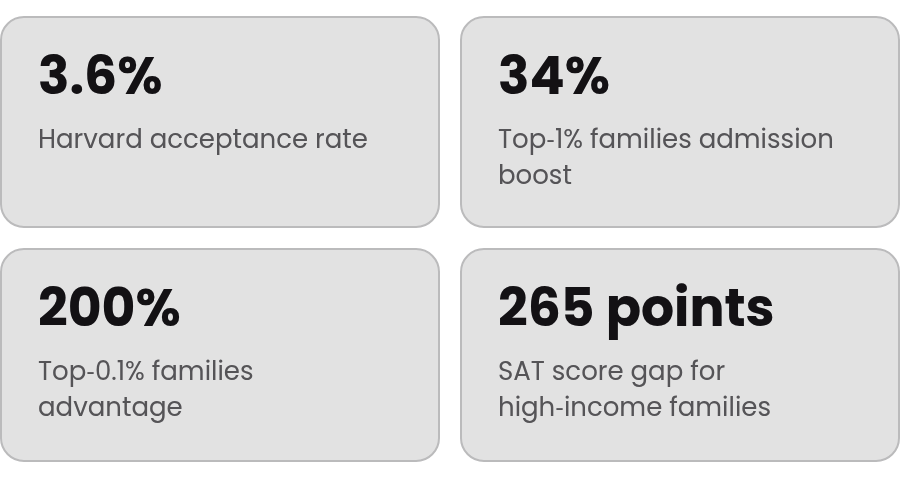
Research pairing federal tax records with admissions data from 30 highly selective institutions found that applicants from top-1% families are 34% more likely to be admitted with the same SAT or ACT scores as middle-income peers. For top-0.1% families, the advantage jumps past 200%. Legacy status, meaning a parent who attended the school, multiplies admission odds by a factor of 3.13 in a multi-institution study. Recruited athletes are admitted at roughly four times the rate of similarly credentialed non-athletes, and one in eight admitted students from the wealthiest families competes in varsity athletics.
The explanation isn't just better test prep. Private feeder schools teach students how to frame extracurriculars, volunteer work, and essays in the language admissions officers reward. Rich applicants score higher on subjective personality and leadership metrics not because they're more compelling people, but because they've been coached to perform compellingness in a 30-second read. An IvyWise counselor who went on The Price Is Right after reading Ivy applications made the parallel plain: producers meet contestants in groups of 10 and give each about 30 seconds to stand out, against a 3% selection rate. She prepared by studying obscure games to show deep knowledge of the show. That's the admissions equivalent of citing a professor's research in your supplemental essay.
The Majority of Students Attend Their First-Choice School—Just Not an Ivy
For families who treat an Ivy as the only satisfying outcome, the counter-narrative matters. A UCLA survey found that more than 67% of college freshmen nationwide were attending their first-choice school. The exclusivity creep at the very top isn't touching most seniors' satisfaction with where they land.
The payoff picture is narrower than the mythology suggests. Attending an Ivy over a top public flagship doesn't raise average earnings, though it does lift the probability of landing in the top 1% of earners from 12% to 19% and nearly doubles the chance of reaching an elite graduate school or a prestigious firm. The advantage is real. It's also specific: it opens doors to prestige networks and tail outcomes, not guaranteed returns for everyone.
The access gap is stark. Students from families earning over $118,000 score 265 points higher on the SAT than those from families earning under $56,000, and they're 77 times more likely to attend an Ivy-level school than students from families making $30,000 or less. The system rewards the ability to invest early and heavily in the credentials admissions offices say they want. We watch families pour resources into test prep, summer programs, and essay coaching without asking whether the return justifies the cost, or whether their student might thrive more in a less punishing environment. The "different game" isn't that Ivies value merit more. It's that they've built a high-cost, low-transparency contest where wealth buys both the credentials and the skill to frame them.
If you're weighing whether to hire a college admissions consultant or build your own strategy, let these structural facts guide you, not the myth that a perfect record guarantees admission or that an Ivy guarantees success.
How Ivies Compare to Other Elite Schools
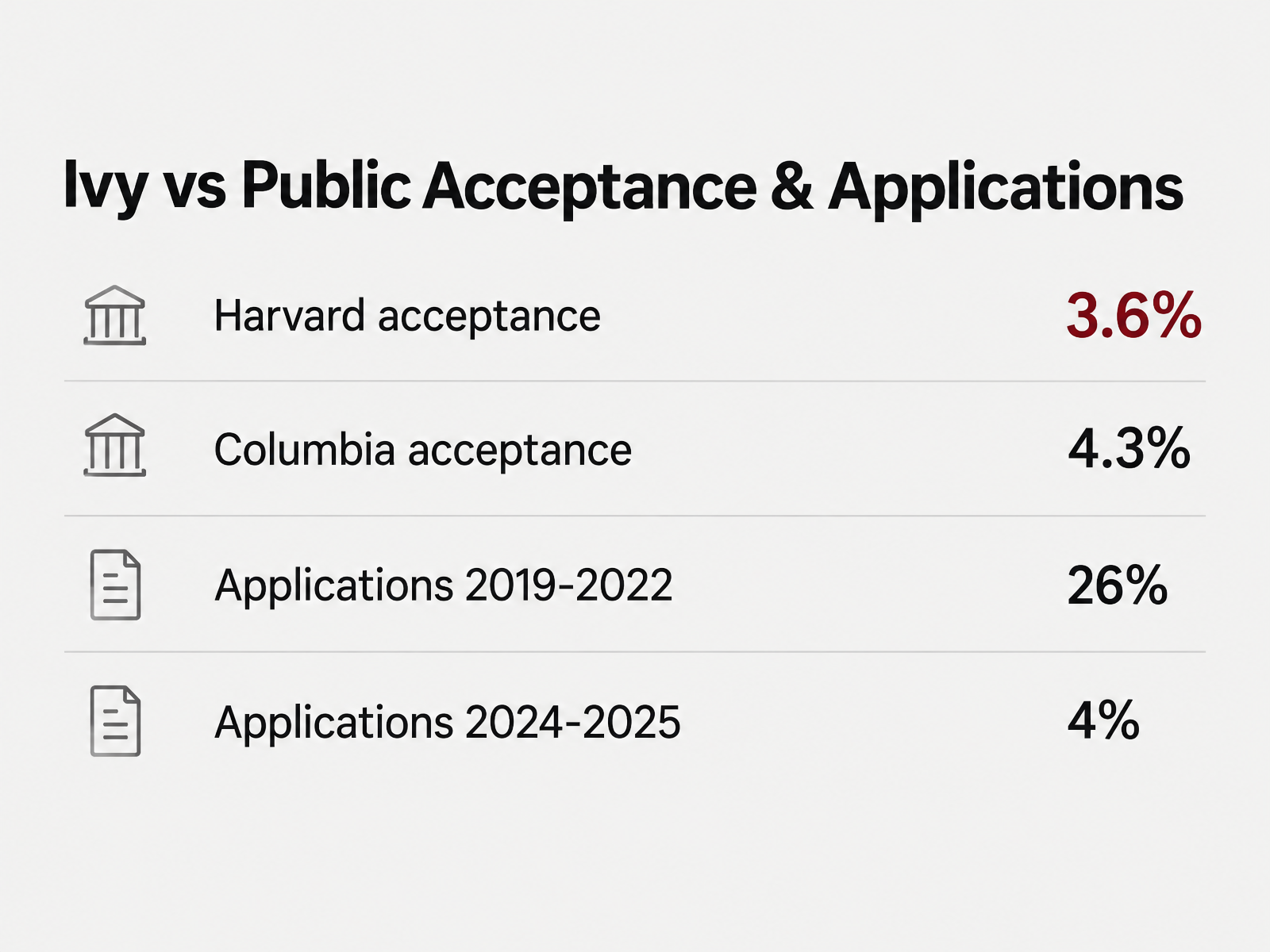
When families line up an Ivy acceptance against a top public flagship, they usually start with one question: which one pays off more? The data refuses to give a clean answer. Harvard's acceptance rate sits at 3.6% and Columbia's at 4.3%, per Times Higher Education. Applications to highly selective colleges rose 26% between 2019 and 2022 and another 4% during the 2024–2025 cycle, according to CollegeData. That pressure pushes families to treat Ivy admission as the only valuable outcome, which is exactly the trap. Top public flagships routinely draw far larger applicant pools than any Ivy, so exclusivity and institutional fit are not the same question.
Aid structure complicates the comparison further. Ivies tend to meet full demonstrated need without parental loans for many families, while top public flagships often reserve their most generous institutional aid for in-state residents and use competitive merit awards to attract out-of-state enrollment. Sticker price tells a family almost nothing about what they'd actually pay. The number that matters is net price after need-based and merit grants. College Essay Guy's guide points out that the schools with the highest published cost can still produce low net costs for families who qualify for need-based aid.
The CEO myth needs a correction too. Executive rosters aren't dominated by a single undergraduate brand. State universities, service academies, and non-Ivy private colleges all show up heavily in leadership pipelines, and boardroom representation varies more by industry and region than by any Ivy name. A brand is not a career requirement.
The outcome picture resists simple rankings. A New York Times Upshot analysis showed that returns hinge heavily on academic field, regional labor markets, and family background. An Ivy campus can shift the kind of opportunity available, but it doesn't rewrite the effect of major choice or geographic mobility. Families chasing prestige networks should price that risk honestly. Families chasing solid income shouldn't assume a top public loses.
| Factor | Ivy League | Non-Ivy / Top Public | Family Strategy |
|---|---|---|---|
| Acceptance rate | Harvard 3.6%, Columbia 4.3% (Cornell higher but similar calibre) | Varies; top flagships can have larger applicant pools but different admit dynamics | Treat Ivy odds as lottery-like; build a balanced list |
| Aid structure | Need-based aid; most avoid parental loans and meet full need | Merit aid common at flagships; need aid varies by residency | Compare net cost after grants, not published price |
| Completion rate | Six-year graduation rates at most Ivies run above 95% | Top public flagships often land in the mid-80s to low 90s | Check graduation by demographic and major, not just college-wide |
| Executive pipeline | A minority of Fortune 100 CEOs; no single Ivy controls leadership | Broad representation from state universities and non-Ivy privates | Treat CEO lists as anecdote, not plan |
| Campus model | Small residential college at Dartmouth; large research university at Cornell | Flagship universities often combine large research scale with honors-college options | Match campus culture and curriculum to student |
Campus Fit: Dartmouth, Cornell, and Columbia Are Not the Same School
The eight Ivies aren't interchangeable. Dartmouth reports more than 60% of classes under 20 students, but Greek life runs heavy. Cornell enrolls about 15,735 undergraduates with roughly 35% Greek affiliation. Columbia requires between 11 and 15 courses outside the major depending on circumstances, according to Expert Admissions. Two students with identical test scores could thrive at one of these and flounder at another.
In our consulting work, we push families to treat these differences as decision variables, not trivia. If you dislike Greek-dominated social scenes, Dartmouth's structure matters more than its name. If you want curricular freedom, Brown's Open Curriculum fits better than Columbia's core. An evidence-based list weighs fit alongside admit rates and aid, because the hidden cost of an Ivy application is time spent chasing a brand that may not suit the student.
Strategic Paths to the Ivy League
When families ask how to approach Ivy admissions, we walk through a few ways to manage ultra-low odds. Not because any one guarantees a seat, but because each reflects a different set of priorities and constraints. You're entering a market where even stellar credentials leave most applicants on the outside.
The Early Single-Target Path: High Conviction, High Risk
This approach means picking one Ivy during early decision and betting your whole cycle on it. The logic is simple: you signal maximum commitment, the school knows you'll enroll if admitted, and early-round pools tend to be smaller. The risk compounds just as fast. You give up the ability to compare aid offers, and if that one school says no, you're back in the regular-decision crowd with months already spent.
Families gravitate here when a student has a clear academic fit, maybe Columbia's structured core or Brown's open curriculum with just two writing requirements, and when finances allow a commitment without comparing packages. The strategy makes sense when you genuinely can't picture attending anywhere else. But families often confuse preference with real fit. Expert Admissions notes that "the more selective the school, the more the question of fit becomes absolutely essential," which means your early-decision essay has to prove you understand what sets that institution apart beyond prestige.
Early acceptance rates often run higher than regular decision, not because standards drop, but because the pool self-selects for demonstrated interest and fit. Penn's early round, for instance, typically fills nearly half the incoming class, rewarding students who've done the homework to know why that specific program serves their goals. The gamble isn't only statistical. It's financial and emotional. You commit before spring scholarship offers arrive, and you end the search before you've had time to figure out what you actually want from four years.
The Broad Balanced-List Path: Portfolio Risk Management
This is the antidote to single-target pressure. You build a list spanning reach schools, match schools, and safeties where admission is statistically likely. In our experience, this path treats admissions as a portfolio problem: diversify so you land somewhere excellent even if every ultra-selective school says no.
The logic sits on selectivity data and volume. When admit rates are lottery-like, a balanced list is the only mathematically sound move. You're not lowering your sights. You're accepting that academic credentials alone won't separate you in pools where Ivies report average admitted profiles well into the top national percentiles.
The trade-off is workload. More schools means more supplemental essays, more campus research, more aid forms. Families burn out trying to tailor applications across too many institutions. Our planning focuses on a manageable number of schools so each application gets genuine attention instead of a recycled essay with the school name swapped. The sweet spot usually lands between eight and twelve: three to four reaches, three to four matches, two to three safeties. Going past fifteen almost always degrades quality faster than it improves odds, because the student runs out of time to write essays that show authentic engagement with each school's specific offerings.
The Experience-Driven Narrative Path: Building Beyond Benchmarks
This strategy flips the usual sequence. Instead of asking "What do Ivies want?" and reverse-engineering a résumé, you start junior year or earlier building tangible signs of passion, what Nelson Urena, a former Cornell admissions officer, describes as "a project, experiment, portfolio, or an endeavor on which they spent substantial time learning, tinkering, or creating." Grades and scores stay central, but they're the entry fee, not the edge. The thing that decides it becomes contextualized achievement.
Why does this matter when academic factors still rank highest? Research drawing on 19 qualitative interviews found that private colleges give meaningful weight to performance capabilities like engagement, leadership, management, professionalism, and teamwork, plus attitudinal traits like adaptability and self-efficacy. These qualities don't replace academic strength. They help readers choose among students who've already cleared the academic bar.
Here's the trap families fall into. They spend months chasing an incremental test-score bump while the rest of the file still shows no sense of direction. Once a student has reached a competitive testing band, extra points often matter less than a passion project that shows sustained intellectual curiosity.
Brad Schiller, an essay coach, defines these projects as "accomplishing something far beyond that of a typical high school student." Not holding a leadership title in debate club, but launching a tutoring nonprofit that served 200 students, or running original materials-science research that led to a regional science fair win. The key is tangible output, not time logged. Admissions officers can tell the difference between a student who spent 300 hours organizing a one-day fundraiser and one who spent 150 hours building a working mobile app that solved a real problem in their community. Depth beats breadth, and impact beats hours.
| Strategic Path | Core Logic | Primary Trade-Off | Best For |
|---|---|---|---|
| Early Single-Target | Maximum commitment signal in early-decision round | Sacrifices aid comparison; high risk if rejected | Students with clear fit and financial flexibility |
| Broad Balanced List | Diversify across reach/match/safety tiers | Heavy workload managing multiple applications | Families treating admissions as portfolio risk |
| Experience-Driven Narrative | Build projects/achievements that differentiate beyond stats | Requires 1–2 years of sustained pre-application work | Students willing to front-load effort before senior year |
Timing: Why Senior Fall Is Already Late
The uncomfortable truth: if you're reading this in the fall of senior year, two of these paths are already half-closed. The experience-driven route needs at least one to two years of runway. You can't fabricate a meaningful research project or scale a nonprofit in three months. Holistic review at selective colleges weighs "the use of student, family, and school background characteristics" alongside nonacademic performance factors, which means officers are assessing whether your achievements reflect genuine engagement or last-minute résumé padding.
Course rigor matters from freshman year forward. Ivy-bound students should be locking in honors and AP tracks by sophomore year, knowing that grades, scores, and course rigor ranked as the most important factors even at schools claiming holistic review. Testing timelines compress faster than families expect: take the SAT or ACT in junior spring, retake once in the fall of senior year if needed, then move on. Your energy is better spent on the narrative only you can write.
Starting the conversation freshman or sophomore year doesn't mean locking a student into a rigid plan. It means understanding the academic baseline, naming genuine interests early, and giving passion projects time to grow real depth. The most compelling applications we see come from students who found a curiosity in ninth grade, pursued it through independent study and mentorship in tenth, shaped it into a research project or community initiative in eleventh, and reflected on what they learned in their senior-year essays. That arc can't be manufactured in six months, and admissions officers know the difference.
Endurable Education's Tailored Ivy Playbook
We work with families facing ultra-low admit rates and rising application volumes every year, and we've built our process around the structural realities that drive decisions at these schools. Admissions staff at highly selective institutions often read thousands of files in a single cycle, and most applications get only a brief first read before committee.
One reality catches families off guard: the application that looks impressive in isolation can still feel generic inside an Ivy review room. A long activity list, a polished résumé, and strong grades don't automatically add up to a coherent case for admission. Families often spend heavily on the most visible parts of the process while the real differentiator, contextualized achievement that fits a school's priorities, gets the least attention.

How We Structure Our Consulting Around Evidence, Not Promises
We split the work into two phases: life preparation and college application. Before the application phase, students build meaningful experiences that fill their activity lists with substance instead of padding. During the application phase, we guide essay strategy, interview prep, and fit-list methodology through a panel approach that brings several perspectives to every draft.
Our team includes Josh, a Princeton and Harvard graduate with over 15 years of admissions counseling experience, alongside Yale and Harvard graduates. We've been ranked #1 in Mainland China for admissions to Harvard, Yale, Princeton, Stanford, and MIT over the past five years, with hundreds of case studies across the US, China, UK, Canada, Hong Kong, and Mexico. More than 50% of our students gain admission to top-10 and Ivy League schools, and almost all are admitted to a top-35 college.
That record rests on three core services: customized planning around each student's strengths and goals, panel-based review that puts multiple sets of eyes on essays and applications, and long-term mentorship starting as early as 8th grade. Admissions readers say consistently that a focused narrative matters more than an overloaded résumé, and our process is built to help students show that focus. Rather than vague promises about "passion" or "fit," our approach is anchored in tailored strategy and steady, collaborative support.
What to Ask Any Admissions Consultant Before You Hire
Ask about advisor credentials: where they worked, how long they read applications, and whether they have real institutional insight. Ask about transparency on scope and pricing; our base-plus-bonus model ties our outcomes to yours. Ask about the feedback process; we offer regular check-ins and panel review, not one-off edits. Ask about fit-list methodology; we build lists that protect narrative quality across every supplement, not shotgun strategies that dilute attention.
Ask whether the service makes outcome guarantees. We don't, because no honest consultant can. What we do commit to is long-term support starting as early as 8th grade, access to our alumni network, and consulting for schools and institutions working to improve student outcomes. We also run mentorship and life-advice sessions beyond admissions, because college is a step, not a finish line.
Skip any consultant who frames a single brand tier as the only path to success. The United States has more than 4,000 degree-granting colleges, and plenty of non-Ivy institutions offer stronger programs in a student's specific area than an Ivy would. The goal is finding the right fit and preparing students for the long term, not chasing a brand for its own sake.
References
[1] A Complete Guide to the Ivy League Schools - College Essay Guy - https://www.collegeessayguy.com/blog/ivy-league-schools
[2] Playing the College Admissions Game - https://thecollegesolution.com/playing-the-college-admissions-game/
[3] The College Admissions Game Show: What Does It Take to Get In? - IvyWise - https://www.ivywise.com/ivywise-knowledgebase/the-college-admissions-game-show-what-does-it-take-to-get-in/
[4] What are the Ivy League schools? - Times Higher Education (THE) - https://www.timeshighereducation.com/student/advice/what-ivy-league
[5] How to Stand Out to Ivy League Colleges and Other Top Schools - https://www.collegedata.com/resources/getting-in/how-to-stand-out-to-ivy-league-colleges-and-other-top-schools
[6] Differences Between Ivy League Schools - Expert Admissions - https://expertadmissions.com/differences-between-ivy-league-schools/
[7] Study of Elite College Admissions Data Suggests Being Very Rich Is ... - https://www.nytimes.com/interactive/2023/07/24/upshot/ivy-league-elite-college-admissions.html
[8] How the Ivy League Broke America - The Atlantic - https://www.theatlantic.com/magazine/archive/2024/12/meritocracy-college-admissions-social-economic-segregation/680392/
[9] The impact of legacy status on undergraduate admissions at elite ... - https://www.researchgate.net/publication/227414369_The_impact_of_legacy_status_on_undergraduate_admissions_at_elite_colleges_and_universities
[10] Holistic Admissions in Higher Education: Challenges and Promise - https://www.researchgate.net/publication/362162300_Holistic_Admissions_in_Higher_Education_Challenges_and_Promise
[11] A Study of the Use of Nonacademic Factors in Holistic Undergraduate ... - https://www.researchgate.net/publication/331745463_A_Study_of_the_Use_of_Nonacademic_Factors_in_Holistic_Undergraduate_Admissions_Reviews
FAQ
1. If my family earns too much for need-based aid but can't afford full Ivy tuition, should I skip early decision?
Usually, yes. Early decision is risky when your family needs leverage or choice on cost. A regular-decision strategy lets you compare net prices, merit awards, and need-based packages before committing.
2. Do Ivy admissions officers actually penalize students who attend large public high schools without name-brand counselors?
Not formally. The disadvantage is usually indirect: students at large public schools may have less access to individualized essay strategy, activity framing, and counselor advocacy. That makes it more important to build a clear narrative from the evidence already in the student's record.
3. How many reach schools should I apply to without burning out on supplemental essays?
Keep the reach category focused enough that every supplement can be specific. For many students, that means a small group of carefully chosen reaches rather than a long list of famous names. The limiting factor is not ambition; it is the time required to research each school well and write convincingly about fit.
4. Does attending an Ivy actually increase my future salary compared to a top public flagship?
The better question is what kind of opportunity you want the college to create. Ivy campuses can offer powerful networks and pathways into elite graduate programs or prestige employers, but major, location, internships, and individual performance still matter enormously. A top public flagship can be the stronger choice when it offers better fit, lower cost, or a superior program in your field.
5. When is it too late to build the passion projects that differentiate Ivy applicants?
Senior fall is usually too late to create depth from scratch. You can still present your existing experiences more clearly, but the strongest projects tend to come from sustained curiosity developed well before applications are due. Sophomore or junior year is a more realistic window for building tangible output.