Why Strong Academics Alone Get Rejected From Ivy League Schools
October 19, 2026

The Short Version
- Harvard's acceptance rate is very low. Many academically qualified applicants are rejected.
- These schools could fill multiple classes with valedictorians and still turn away thousands of qualified students.
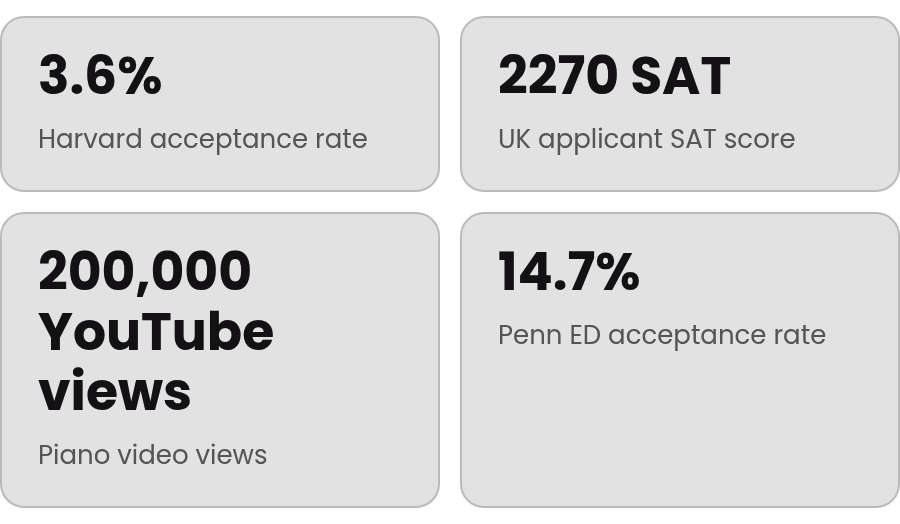
- A UK student with straight A's, a 2270 SAT, and 200,000 YouTube piano views was rejected by all eight Ivies.
- Strong applicants often distinguish themselves through published research, major competition wins, or selection for elite academic programs.
- A focused record of sustained work with measurable outcomes tends to be more persuasive than a long list of activities.
- Essays stand out when they reveal how you think, not when they catalogue what you've done.
Related Video
Watch: Harvard Admissions: Why These 6 Brilliant Students Got Rejected (Leaked Admissions Data Reveals All) by BlueSkies Ivy League Coaching
Why Stellar Academics Aren't Enough
Probably nothing is "wrong" with you. The issue is that stellar academics have become the floor, not the ceiling.
When Perfect Grades Put You in the Middle of the Pack
Harvard's acceptance rate is extremely low, and Yale and Columbia are similarly selective. Tens of thousands of students compete for a few hundred seats. At that scale, even exceptional applicants face long odds: these schools could fill multiple incoming classes entirely with valedictorians and still reject thousands of academically qualified candidates.
Most enrolled students at the most selective universities arrive with perfect or near-perfect GPAs. When that many of your classmates share the distinction, a 4.0 on its own doesn't distinguish you.
Where Most Valedictorians Stall
Top universities assess you across multiple dimensions. Meeting the academic threshold—an unweighted GPA near 4.0, SAT scores in the mid-1400s to high 1500s, or ACT scores from 33 to 35—earns serious consideration. It rarely secures admission by itself.
The highest tier requires evidence beyond strong grades and test scores: published research, a win at a prestigious national competition, or selection for an elite academic program like Research Science Institute or Telluride. That's why excellent numbers can feel like they should be sufficient but seldom are.
What Happens When Everyone Has Your Stats
Students who demonstrate depth in academics, extracurricular leadership, or original research are admitted at rates well above the baseline. The distance between a 1580 SAT with standard involvement and the same score paired with sustained, documented work in one domain can separate rejection from acceptance.
One valedictorian with a 35 ACT was waitlisted at Duke, Vanderbilt, Rice, and Harvard. Strong credentials get your application read carefully. They don't guarantee a spot.
Five Hidden Deal-Breakers for High Achievers
Five recurring weaknesses separate rejected applications from accepted ones among academically similar candidates: shallow extracurricular profiles, essays that read like résumés, recommendation letters without specific anecdotes, institutional fit mismatches, and application strategy errors. These aren't the most common rejection causes across all applicants. They become differentiators once grades and test scores clear the bar.
Surface-Level Activities vs. Documented Impact
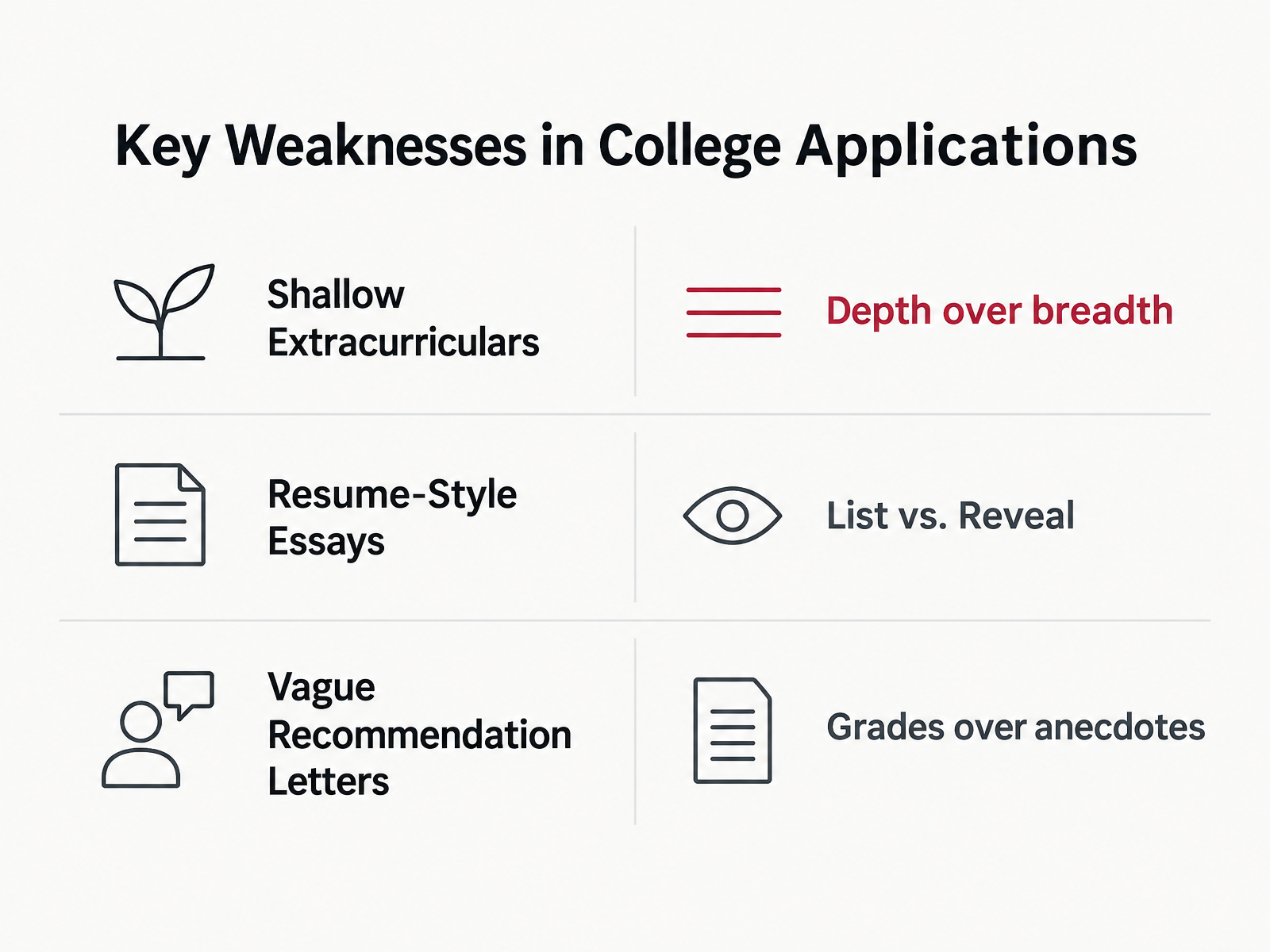
You've seen the well-rounded profile: student council, honor society, varsity sport, community service hours, and leadership titles across ten activities. This profile now gets rejected precisely because it's hard to see what the student actually cares about. A student with three activities and measurable outcomes—a research project, a venture with documented results, a strong competition ranking—gives admissions officers a clearer picture. In an 8-to-15-minute review, a coherent record is easier to understand than scattered data points.
The UK applicant with straight A's, a 2270 SAT, three sports, three languages, Grade 8 piano, and over 200,000 YouTube views on piano videos was rejected by all eight Ivies. The profile showed ability across domains but didn't answer what the student would contribute on campus. Broad interests can signal curiosity. The application still needs to show how those interests developed and why they matter to you.
Essays That List Instead of Reveal
Students with 4.0 GPAs often write essays that enumerate achievements, explain lessons learned, and demonstrate intellectual ability through polished prose. These essays fail because every valedictorian writes them. Essays that stand out show self-awareness, vulnerability, specific moments that mattered, and a voice that sounds like an actual 17-year-old rather than an admissions consultant's template.
Many top students have never been asked to be vulnerable on paper. Their academic success came through competence and execution, not through examining why they care or what they still don't understand. Writing the Common App essay requires unlearning the patterns that earned them straight As: the five-paragraph structure, the thesis-evidence-conclusion rhythm, and the instinct to demonstrate mastery rather than admit uncertainty. Admissions officers can spot inauthentic résumé-padding, where students pursue activities they assume will impress rather than what genuinely interests them. That disconnect can make an essay voice feel manufactured.
Recommendations That Describe Grades, Not People
High-performing students can receive weaker recommendation letters than students with slightly lower GPAs. Valedictorians may prioritize efficient assignment completion and avoid intellectual risks that could affect their grades, while rarely engaging teachers beyond graded work. Teachers know them as "A students" but can't describe their intellectual curiosity or classroom contributions with specifics. A 3.85 student who debates ideas in office hours, takes interpretive risks in papers, and challenges the curriculum may give teachers more memorable material.
Families sometimes treat junior year as the first time to think about recommendations. By September, you've already spent weeks in your teachers' classes. Relationships that lead to detailed letters should begin earlier. The strongest recommendations come from teachers who have watched you develop, not those who have seen only a single semester of work.
Institutional Fit as a Filter
Schools want students who will thrive at their campus, not students who want "any top school." When your essay about why you're applying could be submitted to several universities by changing only the school name, admissions officers notice. Generic references to "world-class faculty," "rigorous academics," or a "diverse student body" are less convincing than program details, course offerings, research groups, or campus resources connected to your interests.
Applicants who can't explain the value they would bring to a particular campus may falter despite academic strength. This isn't about demonstrated-interest metrics. It's about whether your application connects the school to your trajectory and strengths.
Application Strategy Errors
A poorly chosen Early Decision school, an unbalanced list, or neglected demonstrated interest can compound other weaknesses. Strategy is a preventable issue that should be addressed well before senior fall. Applying ED to a reach where your profile doesn't align with institutional priorities can waste a binding option. Skipping ED entirely may forgo an advantage at a school where you're competitive.
Three UK students from the same school, all with perfect grades and 2200+ SAT scores, were rejected from US universities. Their similar school lists, positioning, or essays may have made their applications seem formulaic. When applicants from the same school present nearly identical framing, it can be harder for any one of them to stand out.
Crafting a Personal Story That Sticks
The problem isn't that high-achieving applicants lack material. It's that they approach the essay as another optimization problem, listing accomplishments when admissions officers are looking for presence, not perfection. Students who execute assignments efficiently and avoid risk may produce résumé-like essays, while officers are looking for intellectual vulnerability: moments where you couldn't optimize your way to an answer.
Start With Experiences, Not Achievements
The brainstorming process we use with students inverts the typical approach. Instead of asking what achievement will impress admissions, start by listing four to six specific moments that were uncomfortable, revealing, or changed how you see something. Not the debate tournament win, but the argument with your lab partner that exposed a blind spot in how you collaborate. Not the mission trip, but the conversation with a local resident that challenged your assumptions about what help means.
Ask yourself why you still think about each moment. The answer may reveal a theme—not just what happened, but what it taught you about how you operate in the world. A student who writes about losing a student council election and discovering she cares more about implementing ideas than holding titles has a coherent story. A student who writes about winning that election and lists three initiatives has a résumé entry.
Strong essays balance specificity with reflection. Use concrete detail—the exact moment, sensory specifics, what you actually said—so the reader can picture the scene. Then step back briefly to show what it revealed. Former admissions officers describe this as seeing the human being behind the transcript, not another list of credentials.
When Vulnerability Becomes Performance
Strong students sometimes misstep after hearing that vulnerability matters: they perform risk. They write about a supposedly "risky" topic or adopt an edgy tone, mistaking audacity for authenticity. Real vulnerability can be quieter: admitting uncertainty, describing a mistake without turning it into a triumph, or acknowledging that you don't have an answer yet.
If your essay feels like a TED Talk with a neat resolution, revise it. Admissions officers aren't looking for polished wisdom. They want to see that you've encountered something you can't optimize and are willing to sit with the discomfort instead of packaging it into a lesson.
Building Depth Through Sustained Work
When students map their high school years, they may assume admissions wants a long list: ten activities, perhaps fifteen, with leadership titles spread across student council, honor society, debate team, and several sports. More involvement can seem like a straightforward route to a stronger profile.
Admissions data tells a different story. The three factors that give high-income applicants an admissions advantage at Ivy-Plus colleges—legacy preferences, non-academic credentials, and athletic recruitment—are uncorrelated or even negatively correlated with post-college outcomes. Academic credentials like SAT scores predict success. For applicants, the practical implication is to prioritize activities that demonstrate sustained commitment and concrete results over disconnected roles.
Developing One Focused Strength Over Four Years
We guide students to identify an area where they can develop genuine expertise rather than surface-level participation. That might mean spending several years building a coding project that serves real users, running a tutoring initiative that tracks student progress, or conducting original research that leads to a published paper or conference presentation.
Documentation matters. The activities section should include specific outcomes: dollars raised, people served, problems solved, or recognition earned. A description of what you founded, whom you reached, and what changed conveys initiative. A line saying you were a club member says little about your contribution.
Admissions officers at competitive schools describe reading applications multiple times and discussing their impressions in groups. They're looking for evidence that an applicant identified something that mattered and pursued it long enough to produce tangible results. A sustained project can show how you work through setbacks as well as what you accomplished.
Application Planning: Fit, Timing, and Demonstrated Interest
You can spend months perfecting GPAs and essays, then undermine your chances with a school list based on rankings rather than alignment. A sound plan considers which campuses match your interests, whether an early-round application is appropriate, and how to communicate that fit in supplements.
Why Institutional Fit Matters More Than Brand
When we review a student's school list, we often find the same eight Ivies plus Stanford and MIT, chosen purely by US News rank. The differentiator isn't just your stats. It's whether your application shows an understanding of what makes each campus distinct.
Brown's open curriculum draws students who want to design interdisciplinary paths. Penn's pre-professional culture suits students launching ventures or aiming for Wharton's dual-degree programs. Columbia's Core appeals to students who want structured humanities grounding. When a "Why Us?" essay could swap one school's name for another, it loses credibility.
The fit framework we use with students starts with three questions: Does the academic structure match how you learn? Can you name specific faculty, labs, or programs you'd engage with in your first year? Does the campus culture reward the kind of impact you've already demonstrated? If you can't answer those concretely for a school, it may not belong on your list.
Building a Balanced List That Accounts for Selectivity
Students with 4.0 GPAs may assume their safety schools are targets and their targets are reaches. The data illustrates the uncertainty: Yale admitted students from a recent cycle, while Princeton's class size is capped near 1,500 despite receiving over 40,000 applications. A rejection at this level is not, by itself, evidence of a weak profile.
A functional list includes schools across three selectivity bands, defined by your profile. Reaches are schools where your stats fall in the lower half of the admitted range. Targets are schools where you're at or above the median. Safeties are schools where you're in the top quartile and the acceptance rate exceeds 30%. Many high-achieving students underestimate how many safeties they need. Two may not be enough when every reach admits under 10%.
The Early Decision Timing Calculus
Early Decision acceptance rates run two to three times higher than Regular Decision at many Ivies. That advantage matters only if your application is ready.
Students who rush ED applications in November of senior year may have drafted essays in October and built teacher relationships in September. That compressed timeline can lead to generic supplements and lukewarm recommendations. Those who begin school research and relationship-building earlier have more time to make their applications specific and considered.

If your top-choice school offers ED and your profile is competitive, applying early may make sense. If you're still developing your application or your test scores aren't where they need to be, Regular Decision gives you more time. Don't use a binding option on a school where you aren't yet competitive simply because the acceptance rate looks better.
Quick Reference: Key Components and Planning Timeline
The table below gathers the main application components in one place. Use it to check whether each part supports a clear account of your interests, abilities, and fit.
| Academic Foundation | Extracurricular Depth | Essay Authenticity | Recommendation Specificity | Institutional Alignment |
|---|---|---|---|---|
| Most rigorous curriculum available at your school | A focused set of deeply pursued activities with measurable outcomes | Personal voice revealing genuine reflection, not achievement recap | Teacher can cite specific intellectual moments and character examples | Research matches between your interests and school's programs, faculty, culture |
| Strong GPA in context of school profile | Evidence of initiative: launched, led, or created something tangible | Vulnerable moments where optimization wasn't possible | Engages teacher outside class: office hours, debate, intellectual risk | Supplements show you understand what makes this campus distinct |
| Test scores (where required) that clear the competitive threshold | National, regional, or state-level recognition in at least one area | Specific scenes and sensory detail, not abstract statements | Letter reads as advocacy, not summary | Early application when profile is ready (not rushed to meet ED deadline) |
| Upward grade trajectory or clear context for any dips | Sustained commitment over multiple years, not title-chasing breadth | Avoids sounding like every other high-achiever's essay | Recommender knows you well enough to compare you favorably to peers | Demonstrated interest appropriate to school's policy (some track, some don't) |
Four Planning Stages
Sophomore year (or earlier):
Begin identifying one or two areas where you can build real depth rather than collecting activity titles. Research on admissions priorities points toward impact over number of involvements. Start the teacher relationships that can support detailed recommendations.
Junior year (September through May):
Finalize course rigor, take standardized tests if required, and research schools beyond rankings. Identify teachers who have seen you engage intellectually, not just earn As. By May, decide whether Early Decision fits your timeline and financial situation. Make sure your activities and interests form a coherent picture.
Summer before senior year:
Draft your Common App essay and start supplements. Check whether your activities tell a story or simply fill space. If a draft reads like a résumé, reframe it around a moment that reveals genuine curiosity or a change in perspective.
Senior fall (application season):
Complete applications, submit materials on time, and avoid last-minute strategy shifts. If you're deferred or waitlisted, a letter of continued interest can clarify recent developments and reaffirm fit, provided you have substantive updates to share.
Common Pitfalls
Relying on perfect grades alone for differentiation. Academic credentials are the baseline, not the finish line.
Surface-level participation in many activities instead of sustained initiative with measurable results. Officers can see when a list of involvements lacks evidence of contribution.
Generic essays that describe lessons learned or list accomplishments rather than revealing how you think and who you are.
Teacher recommendations that summarize your grades but can't cite a memorable classroom moment or intellectual risk.
Applying to all eight Ivies because they share high rankings, without researching which campuses match your interests, learning preferences, or intended major. A mismatch can show in the supplements.
Notes for Families
Don't assume a two-year timeline is mandatory. Some students build depth starting sophomore year. Others accelerate junior year. What matters is the coherence of the work, not how long it took.
Don't expect perfect stats to override a weak narrative. Academic strength alone doesn't explain why you belong at a particular school. Your application should convey your interests and perspective.
Don't ignore financial fit. Run net price calculators before applying early decision anywhere. Ivy League schools meet full demonstrated need, but your family's definition of affordability may differ from the financial aid formula.
Don't neglect match and safety schools. Many students who apply to highly selective universities attend excellent institutions outside the top ten. A balanced list accounts for the uncertainty of selective admissions.
We see families lose sight of these fundamentals when rankings dominate school selection. You often benefit from spending less time chasing prestige and more time clarifying what you want from college and how your experience shows you're ready for it.
References
[1] Why Valedictorians Get Rejected from Ivy League - Oriel Admissions - https://orieladmissions.com/ivy-league-rejected-valedictorian-perfect-students-denied/
[2] Why Top Students Are Getting Rejected From The Ivy League - https://www.forbes.com/sites/christopherrim/2024/04/10/why-top-students-are-getting-rejected-from-the-ivy-league/
[3] Rejected by all 8 Ivy leagues with straight As and 2270 SAT - https://talk.collegeconfidential.com/t/rejected-by-all-8-ivy-leagues-with-straight-as-and-2270-sat/1803573
[4] Getting Rejected From Elite Universities - The College Solution - https://thecollegesolution.com/getting-rejected-elite-universities/
[5] [PDF] Diversifying Society's Leaders? The Determinants and Causal Effects of ... - https://opportunityinsights.org/wp-content/uploads/2023/07/CollegeAdmissions_Paper.pdf
[6] Ivy League Admissions Process: What Officers Look For - https://orieladmissions.com/ivy-league-admissions-process-what-officers-look-for/
[7] How Hard is it to Get into an Ivy League School? - C2 Education - https://www.c2educate.com/blog/getting-into-ivy-league-schools/
[8] How Ivy League Admissions Officers Rate Your Application - https://www.collegeadvisor.com/resources/ivy-league-application/
[9] How Ivy League Schools Review Applications - Fortuna Admissions - https://fortunaadmissions.com/college/how-ivy-league-schools-review-applications/
[10] How To Get Into An Ivy League School? The Essential Guide - https://www.crimsoneducation.org/us/blog/how-to-get-into-an-ivy-league-school
[11] Harvard Admissions: Why These 6 Brilliant Students Got Rejected (Leaked Admissions Data Reveals All) by BlueSkies Ivy League Coaching - https://www.youtube.com/watch?v=T-VY7jhVIhc
FAQ
If I have a 4.0 GPA and high test scores, what single thing would most improve my chances at an Ivy League school?
Build sustained work in an area that matters to you and document what it accomplishes. The activities section should make your contribution clear rather than relying on grades to carry the application.
Should I apply Early Decision if my application isn't completely ready by November?
Apply Early Decision only when your essays and recommendations are ready to represent you well. The higher ED acceptance rates discussed above do not compensate for rushed materials.
How many safety schools do I actually need if my stats are competitive for Ivies?
Choose safeties where your academic profile is strong and the acceptance rate is substantially higher than that of your reach schools. A balanced list should reflect how unpredictable selective admissions can be.
What makes a recommendation letter strong if I already have straight As in that teacher's class?
A strong letter gives specific examples of how you think and participate, not just confirmation of your grades. Teachers need enough experience with your questions, classroom contributions, or intellectual risks to describe you as a person.