Cornell's Acceptance Rate by College: Where Your Odds Actually Sit
September 25, 2026

Cornell's acceptance rate isn't one number
Cornell doesn't have a single acceptance rate. You apply to one undergraduate college, and each runs its own admissions process with its own bar. Reported university-wide rates have been in the single digits in recent cycles, but that figure hides a wide spread once you sort by school.
That spread is why many advisors read Cornell by profile instead of by headline. The same mistake shows up often: a student sees the single-digit number, then panics or writes the whole place off. Your real odds often depend on which college matches your GPA, scores, and activity list. A strong STEM profile may read very differently in Engineering than in Arts and Sciences.
Here's the quick view. Exact rates move year to year, so treat these as relative tiers, not fixed percentages.
| Cornell College | Relative competitiveness | What shifts your odds most |
|---|---|---|
| Arts & Sciences | Very high | Academic breadth, essay voice, intellectual curiosity |
| Engineering | Very high | Math and science rigor, quantitative scores |
| SC Johnson (Dyson) | Very high | Business fit, leadership, quantitative strength |
| CALS | Moderate to high | Genuine interest in your specific major |
| Human Ecology | Moderate | Alignment with the program's mission |
| ILR | Moderate | Interest in labor, policy, writing, and debate |
| AAP (Architecture) | Very high | Portfolio and demonstrated design talent |
Your target college matters more than your raw stats
Pick the wrong college and a strong applicant can look average. Pick the right one and the same profile may jump a tier. Cornell's contract-college structure often rewards students who match a school's specific focus, not just students with high numbers, so fit can carry real weight.
For example, a 3.9 GPA with deep agriculture research may read stronger in an agriculture and life sciences college than in a broader arts-and-sciences pool. If your activities point clearly toward labor relations or public policy, a labor-focused college may use them better than a generalist application to a more crowded college. Don't ask whether you can get into Cornell in the abstract. Ask which Cornell college your profile fits, then aim there.
What you need to know
- Reported college-level acceptance rates have varied widely across Cornell's undergraduate colleges, with some specialized programs appearing more selective than others.
- Cornell's undergraduate colleges each maintain their own admissions process, so there is no single university-wide rate that applies evenly.
- The contract-college structure may reward applicants whose interests match a college's specific focus, so target college can matter as much as raw GPA or test scores.
- For example, a 3.9 GPA with agriculture research may read stronger in an agriculture and life sciences context than in a broad arts-and-sciences pool.
- Three inputs commonly shape odds together: GPA and rigor, test scores in quantitative pools, and extracurricular impact.
- Architecture admissions often hinge on portfolio and demonstrated design talent; ILR may favor applicants drawn to labor, policy, writing, and debate.
- Overall-rate guessing, chance-me forums, and ranking-site calculators often estimate a blended university number rather than how a record reads across Cornell's separate colleges.

When an odds read actually earns its place
Not every student needs a formal odds tool. If you're set on one college, love the fit, and already know your numbers clear the bar, skip the extra analysis and write strong essays. The value shows up when you're undecided between Cornell options and want a clear read on which one your profile actually favors.
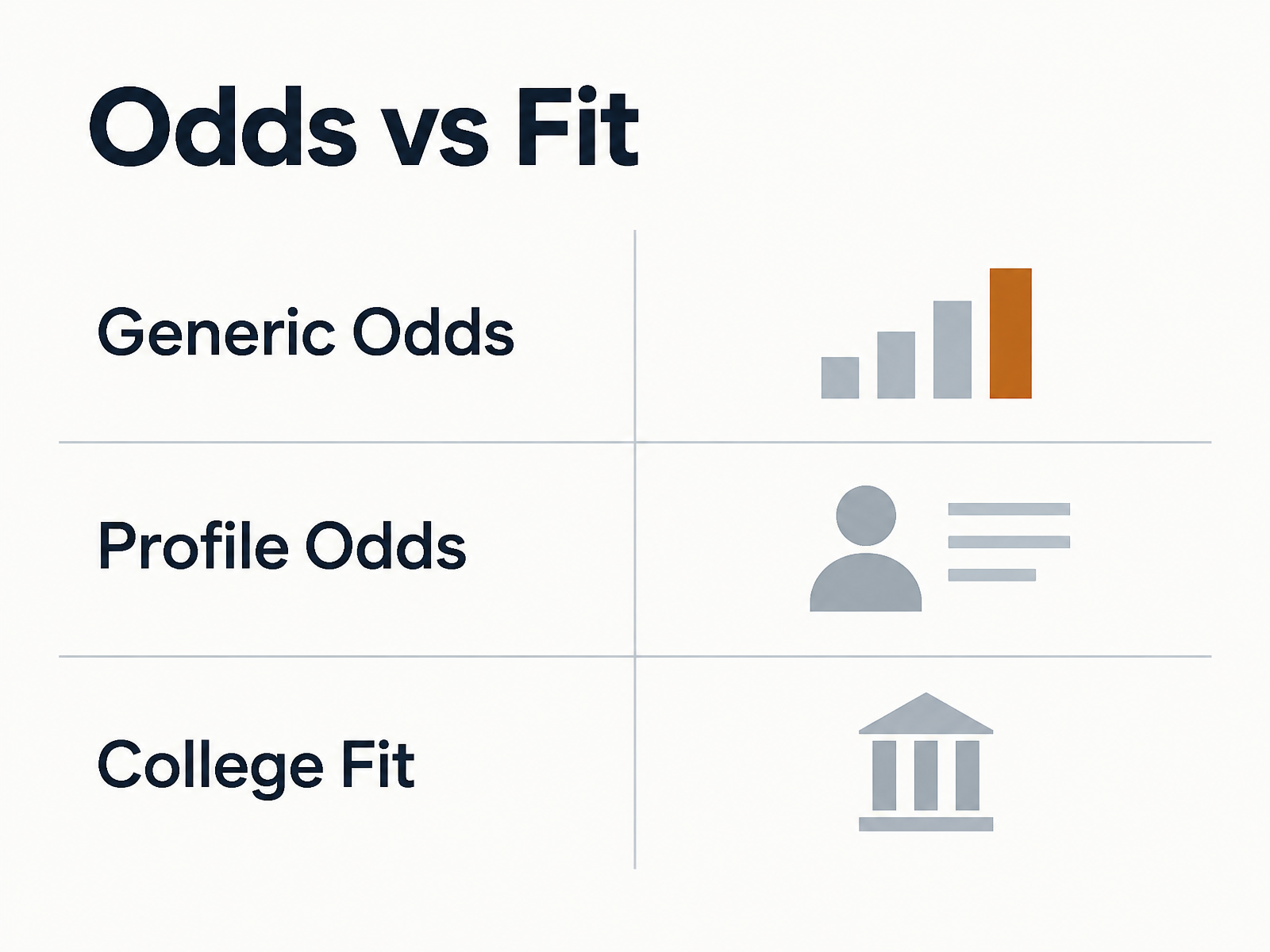
That's where many families get stuck. Generic ranking sites and free chance-me forums often flatten Cornell into one answer, so they can't tell you whether a technical, policy, design, or life-sciences record has the cleanest path. A profile-based admissions review can separate those reads, then match your GPA, scores, and activity list to the college where they may make the strongest case.

Where a mentor beats the free tools
Here's how the common approaches stack up.
| Approach | What it estimates | Best for |
|---|---|---|
| Overall-rate guessing | One blended number | A rough gut check, nothing more |
| Free "chance me" forums | Crowd opinions | Casual sanity checks |
| Ranking-site calculators | School-wide averages | Building an initial list |
| Profile-based admissions mentorship | How your record may read across Cornell's colleges | Choosing which college to target |
The first three tend to answer whether you can get into Cornell overall. A profile-based review can focus on a sharper question: given your record, which Cornell college fits you best. That distinction can change real decisions, since you apply to one college, not the university at large.
That decision often comes down to three inputs. Your GPA and rigor tend to carry the most consistent pull. Your test scores may matter more where the applicant pool skews quantitative. Your extracurriculars may swing hardest when they signal genuine impact, not just a long list, a factor discussed in our constraint check on impact and risk-taking.
If your record leans hard toward one field, profile-based planning can help you target the college where that strength reads loudest. If it's balanced, it can help you find the college that rewards breadth. Either way, you choose with a strategy instead of the headline number everyone else fixates on.
What each tool actually measures
Most tools that promise to estimate Cornell odds share one flaw. They treat the university as a single number, then attach a slider to your GPA and call it a prediction. The real differences show up when you compare what each option measures. A profile-based read can look at college-level fit instead of one blended estimate.
Here's how the common options may stack up on the features that matter for a serious read.
| Feature | Free Chance-Me Calculators | Generic Ranking Sites | Profile-Based Advising |
|---|---|---|---|
| Customized plan built around your goals | Often not | Often not | Varies by provider |
| Panel review from multiple advisors | Often not | Often not | Varies by provider |
| Reads extracurricular fit to the school | Often not | Often not | Varies by provider |
| Essay and supplement guidance | Often not | Often not | Varies by provider |
| Adjusts for STEM vs. Humanities profile | Often not | Often not | Varies by provider |
| Human review of your actual record | Often not | Often not | Varies by provider |
The gap is often widest on the middle rows. A free calculator might give you a broad selectivity warning, but it may not judge whether a robotics portfolio belongs in an engineering narrative, a broader liberal-arts story, or somewhere else. Ranking sites often do even less: they report and stop.
What sets us apart: a panel reads your whole story
Fit is often the whole game. Grades and scores don't tell the complete story, and a flat calculator may not capture that. Some advising services pair each student with a team that reviews the full record and builds a plan around strengths and goals.
Some services work as a panel rather than one-on-one, so an essay may be reviewed by more than one person for different perspectives on how the application lands. They may help refine the story and develop the activities, essays, and interview answers that set you apart. If you're locked into one college and your numbers already clear it, you may not need this layer. The collaborative read matters most when your target is still unsettled and you want an honest sense of where your profile fits best.
Fast answers vs. answers you can use
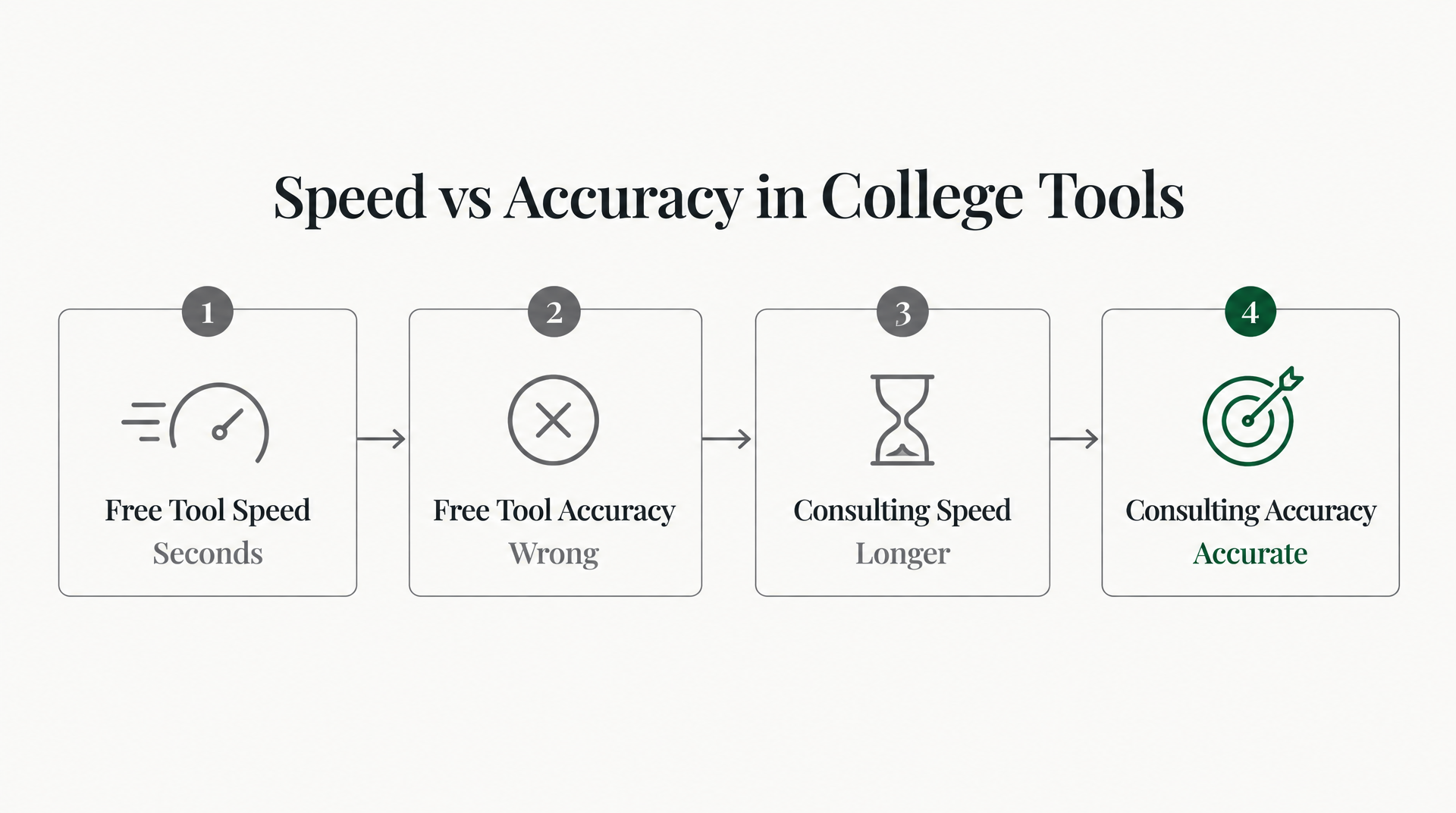
Speed matters more than families expect during application season. A free chance-me form can return a number in seconds, but that number may answer the wrong question. It may estimate Cornell as a whole, not how your record lands inside the specific college you'd actually apply to. Fast and wrong isn't a win.
Profile-based advising tends to trade raw speed for a read that holds up better. It often takes longer on the first pass because it builds a plan around your strengths and goals rather than a single blurry figure. That is the work that can produce an answer you can act on.
The speed-versus-accuracy trade nobody names
Think of it as effort in, signal out. A calculator asks almost nothing of you and returns a broad estimate. A profile-based review asks for more context up front, then turns that context into a strategy tied to your actual application choices.
| Dimension | Free Calculators | Ranking Sites | Profile-Based Advising |
|---|---|---|---|
| Tailored to your profile | Often not | Often not | Varies by provider |
| Panel review of your application | Often not | Often not | Varies by provider |
| Effort required from you | Minimal | Minimal | Often moderate |
| Answer you can build a plan on | Often not | Often not | Varies by provider |
The slower part can pay off in the quality of the diagnosis. Once a provider understands your profile, the review can show whether the application needs sharper academic framing, clearer activity evidence, or a tighter explanation of why one college fits better than another. Regular check-ins may keep you on track as you refine your story.
When the fast tool is enough
Skip the deeper analysis if you're locked on one college and your numbers already clear its typical range. A quick calculator can serve as a sanity check, and your time is better spent on essays. No reason to pay for a full read when the decision is already made.
The value shows up when your academic interests, activities, and intended major don't all point the same direction. There, a few days of careful comparison can keep you from sending a strong file to the wrong audience.
The trade-offs, laid out
Every option for reading Cornell odds carries a trade-off. Fast tools often cost nothing and answer immediately, but that answer is usually a blended read. Profile-based advising may cost more and take longer, yet it can help identify which college-level audience is most likely to value your record. Pick based on what you need, not what's cheapest.
Here's a scorecard for weighing these paths.
| Trade-off | Free Chance-Me Tools | Generic Ranking Sites | Profile-Based Read |
|---|---|---|---|
| Cost | Free | Free | Often paid |
| Customized plan for your strengths | Often not | Often not | May include |
| Reviewed by two-plus advisors | Often not | Often not | May include |
| Human judgment on fit | Often not | Often not | May include |
| Best for | A rough gut check | Building a school list | An undecided-college decision |
When should you skip the paid read?
Skip formal advising if you already know your target college and your numbers clearly clear its bar. A committed hotel-management applicant with strong grades and a resume built around the field may only need a free tool to confirm the obvious. Paying for a panel review there may buy little.
Same goes for very early-stage students. A sophomore still building a transcript doesn't need a probability read yet. Focus on the GPA and activities first, then run the odds when your profile is closer to final.
Where does the trade-off pay off?
The paid path may earn its cost when the college choice itself is the strategic problem. A single blended number can hide the fact that the same applicant may look merely solid in one pool and unusually well matched in another.
A profile-based review can build a plan around your strengths and pressure-test the essays each college's supplement demands. Instead of treating the supplement as a generic "why Cornell" exercise, it can look at whether your activities, academic choices, and intended major reinforce one another. This is more involved than a quick automated tool, but if you value judgment over speed, the trade may land in your favor.
Who this actually helps
Two students with nearly identical transcripts. One is a coder with a robotics award. The other runs a food-justice nonprofit and loves biology. Same GPA, same test band, but the college-level fit can look very different once you sort by school. That split is where profile-based planning may serve best.
This approach is often built for the applicant whose file could make sense in more than one place. If you already love one college and your numbers clear its bar, a full read may not be necessary. But when your record could plausibly support a technical, liberal-arts, or applied life-sciences direction, profile-based advising may earn its keep. Some providers use admissions experience to build a strategy around your strengths and goals, helping you show your best where it reads strongest.
Who gets the most from customized consulting?
Some students benefit far more than others. Here's one way to sort it.
| Student Profile | Best Fit Option | Why |
|---|---|---|
| Set on one college, strong numbers | Focus on your supplements | You just need essays, not analysis |
| Building a broad school list | Generic ranking sites | Fast, wide, low-stakes |
| Torn between two-plus Cornell colleges | Profile-based planning | Tailored strategy matched to your strengths |
| Strong record, unclear where it fits | A panel approach | Diverse perspectives on where your file fits |
The pattern is clear. The more your profile could swing between colleges, the less useful a blended estimate may become.
When should you skip the deep read?
Be honest with yourself. If you're a strong fit for one program and your only real gap is a polished supplement, spend your energy on writing, not odds modeling. The extra analysis may not move your decision.
The deep read often pays off when the choice of college genuinely changes your chances. A STEM-heavy applicant comparing a specialized technical path with a broader science route is one example. So is a student whose activities point one direction while their intended major points another.
A profile-based review tends to be most useful when your file is strong but ambiguous. If you want to see how impact and risk-taking factor in, our Ivy admissions constraint check breaks down what actually moves a competitive read.
The bottom line on your Cornell odds
Cornell isn't one admissions decision. It's a set of college-level reads, each with its own bar, its own essays, and its own way of interpreting your profile. The overall single-digit rate may tell you little about where your record actually lands.
Your GPA, test scores, and activity list don't produce one universal answer. They change meaning depending on the college reviewing them. Sort your odds by college, and the picture sharpens fast.
So here's how to steer yourself, based on where you stand.
Match the tool to your situation
| Your Situation | Best Choice |
|---|---|
| You already love one college and clear its bar | Skip the analysis. Write strong essays. |
| You want a rough gut check | A free chance-me calculator |
| You're building a wide school list | A generic ranking site |
| You're torn between two or three Cornell colleges | Profile-based customized planning |
Only one row may need the deeper service. If you're set on a single college and your numbers are solid, a full review may not be necessary. Paying for a full read when the path is obvious can waste money.
A profile-based read may earn its place with the undecided applicant whose record could point at more than one college. That's where a blended estimate can fail and a tailored read may help. The goal is to build a plan around your strengths and goals, so you show your best where it counts.
The one decision that moves your odds most
Picking the right college to apply to may shift your acceptance odds more than small cosmetic tweaks elsewhere in the file. Same transcript, different reader, and the application can be judged differently. That choice deserves more than a slider.
If you're weighing which Cornell college fits your profile, a panel-based review may be worth considering. Some providers review the application as a group, drawing on admissions experience, so you can see how your story reads and show your best.
References
[1] Undergraduate admissions - Institutional Research & Planning - https://irp.dpb.cornell.edu/university-factbook/undergraduate-admissions
[2] Cornell University Acceptance Rate and Admissions Strategies - https://www.collegetransitions.com/blog/how-to-get-into-cornell-admissions-data-and-strategies/
[3] Cornell University Acceptance Rate for Class of 2030 - IvyWise - https://www.ivywise.com/blog/cornell-university-acceptance-rate/
[4] Cornell University Admissions - BigFuture College Search - https://bigfuture.collegeboard.org/colleges/cornell-university/admissions
[5] Cornell University: Inside the Numbers - College Transitions - https://www.collegetransitions.com/blog/cornell-university-inside-the-numbers/
Quick Questions, Straight Answers
Which Cornell college has the lowest acceptance rate?
Reported college-level breakdowns have varied by cycle. In a cited 2023 breakdown referenced above, Hotel Administration sat at the most selective end of the Cornell range. Use that as a competitiveness signal, not as a permanent ranking, because college-level rates move from cycle to cycle.
Can I apply to more than one Cornell college at the same time?
No. Your application is read by the undergraduate college you choose, so the strategic question is not whether Cornell likes you in the abstract. It is whether the college you select is the right audience for your academic interests, activities, and essays.
My grades and activities are spread evenly across subjects, so which college fits best?
A balanced profile can work well when the application shows a clear intellectual through-line rather than a random mix of interests. Look for the college where your essays can explain why your coursework, activities, and intended major belong together.
I'm a sophomore, so should I run my Cornell odds now?
Hold off on probability modeling for now. At that stage, the better move is to strengthen the transcript, deepen a few activities, and gather evidence of real initiative. An odds read becomes more useful once the core profile is closer to complete.