How a Former Yale Reader Scores Your Stanford Application in 90 Seconds
September 27, 2026
Before we get into it, the short version:
- Stanford reads contextually. Your record is judged against what your school offered, not a national bar.
- Experienced readers move fast because they know their assigned high schools.
- The academic scan asks one thing: does your strongest recent coursework support the story your application tells?
- Deep commitment to one or two things usually reads better than a thin list of six.
Why a Fast Read Is on Your Side
Stanford practices holistic admission. Every part of your file gets read as one piece, not scored on a checklist. In a pool this competitive, a scattered application cannot make its case, so the first read carries real weight. The skill we teach is learning to see your own file the way a reader will, before the reader ever opens it.
Speed sounds like the enemy of careful review. It isn't. A fast read lets you fix the right thing early, while you still have months to work instead of days. Most of the worry families bring us comes from feedback that arrives vague and late. A quick, focused read trades that fog for a specific verdict you can act on.
How can a reader score you that fast?
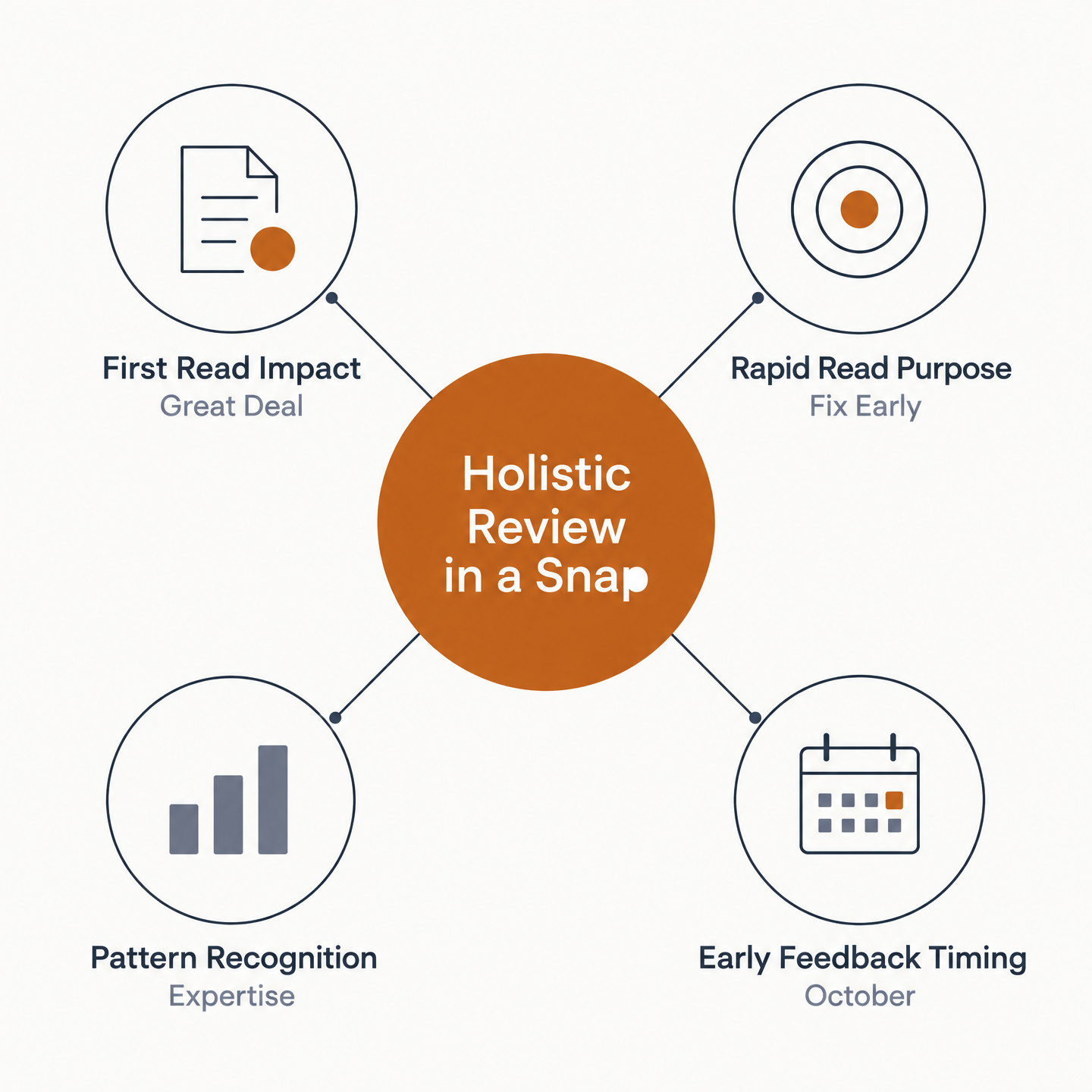
Rapid scoring is trained pattern recognition, not box-checking. Stanford readers work geographic territories and know each high school's profile cold, so they aren't judging you in a vacuum. They're matching your file against a context they already carry in their head.
That resolves an apparent contradiction. The College Board argues holistic review is rational human judgment and warns that the black box myth does not help. A former Stanford reader describes scoring fast enough that a coherent applicant reads in a single sentence. Both are true. Speed is the product of expertise, not a shortcut around it.
That's why we read for the same pattern-match. Every one of our students' applications gets reviewed by at least two people on the team. If your file doesn't resolve into one clear persona quickly for us, it won't for the committee.
What does a fast read actually catch?
It surfaces the gap your transcript can't close. Grades prove academic strength. They say nothing about intellectual vitality, and that gap is where the essay comes in. A fast read tells you instantly whether your essay is doing that job or wasting the space.
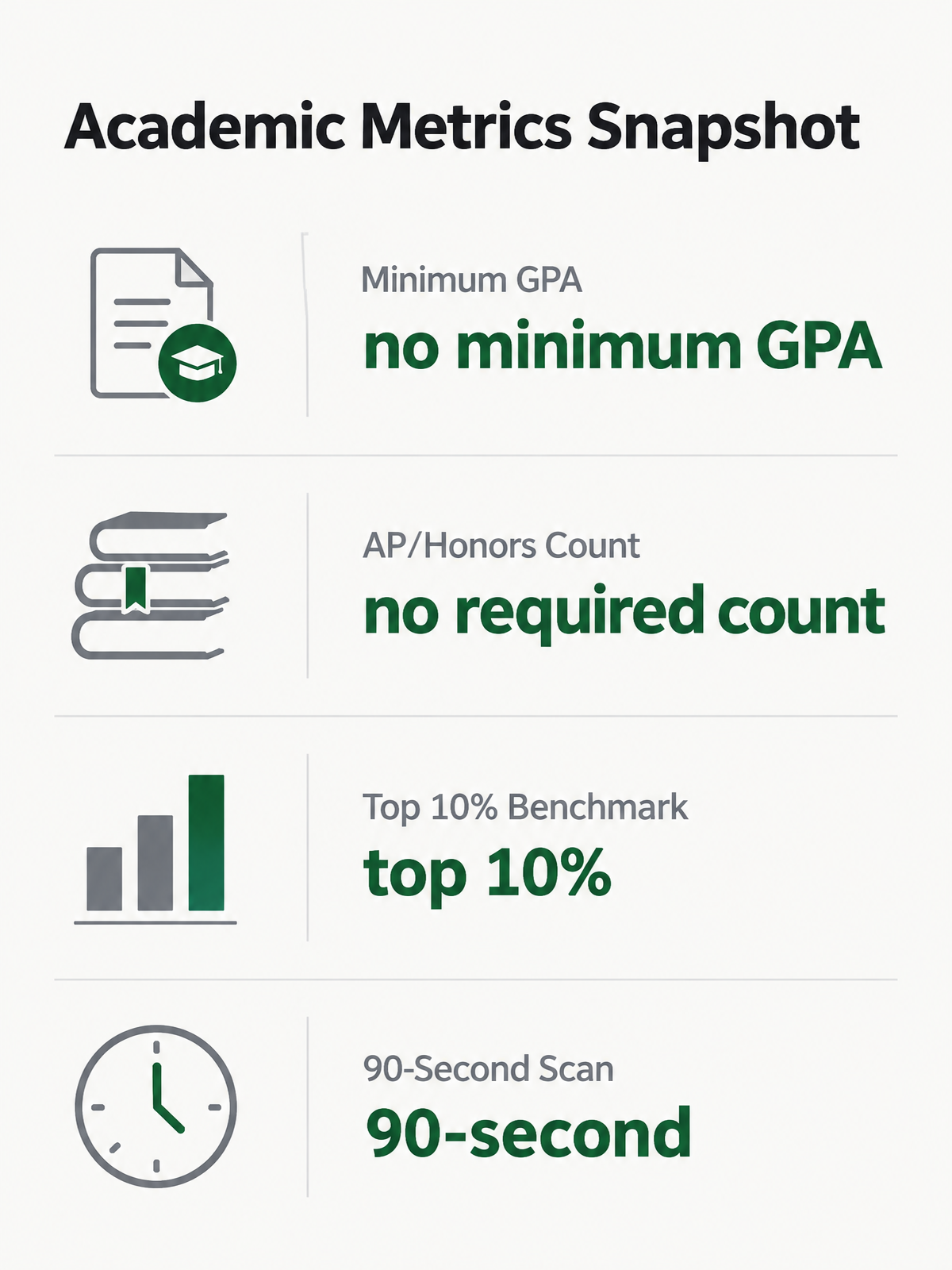
Stanford's own standard is contextual, not numeric. The admissions office states there's no minimum GPA and no required number of AP courses; every metric is read against your school. Strong grades in a demanding program matter, but they're weighed against your environment, not a fixed cutoff. Once your record clears that contextual bar, the essay carries the decision.
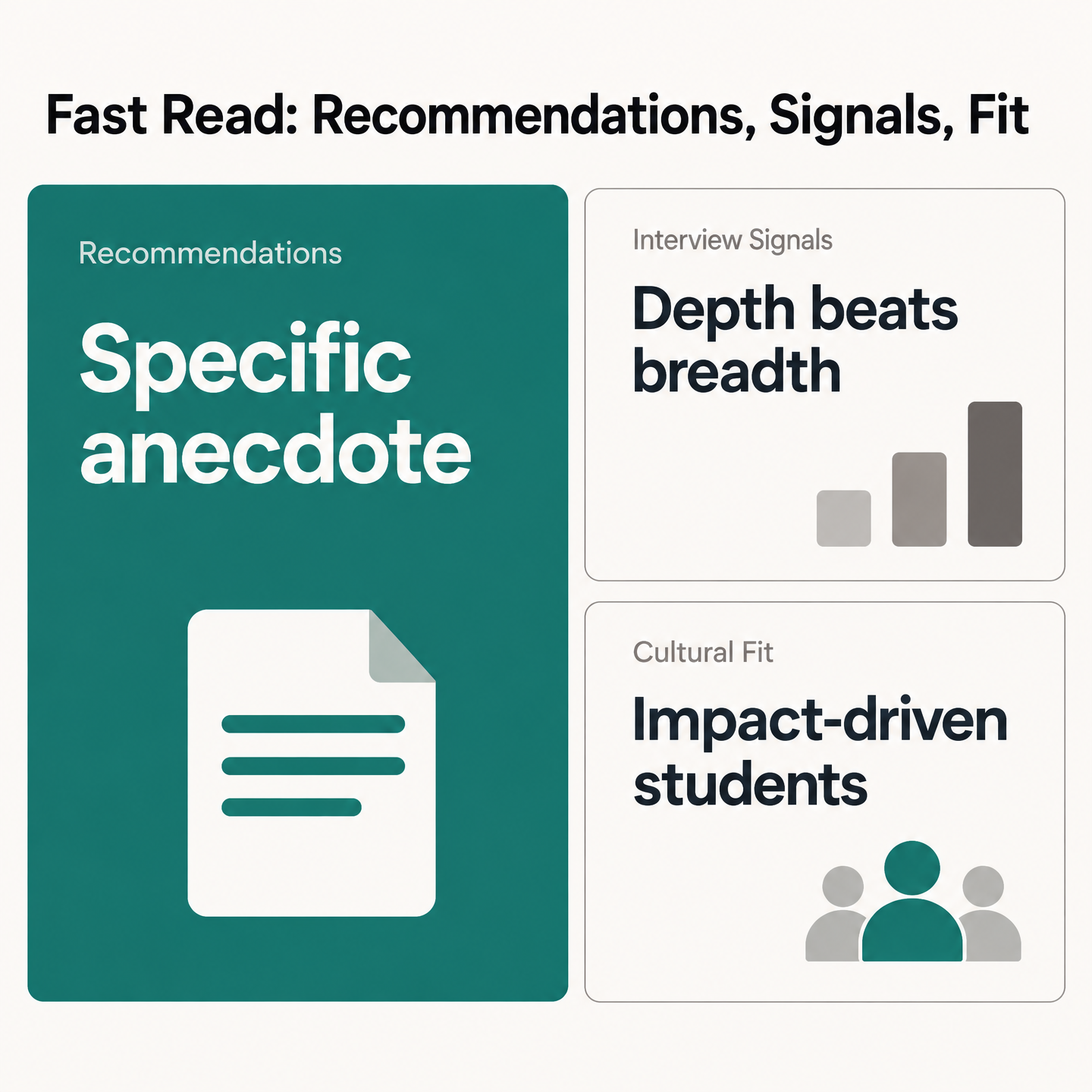
Depth beats breadth here too. Stanford says plainly that deep experience in one or two activities can signal more than thin involvement in six. A fast read flags padding right away.
When does a fast read pay off most?
Early. You want to run the diagnostic while the application is still soft. That gives you a clear target with time to rethink an essay, sharpen an activity description, or cut a line that muddies the pattern.
The one time to skip it: when your draft doesn't exist yet. This is a diagnostic for real material, not a replacement for writing something. Once you have a genuine draft, the fastest read is also the most honest one. We map out the signals beyond grades in our guide to the four non-academic signals that separate admits from rejections.
Academic Metrics in 90 Seconds
A reader scanning your transcript isn't hunting for a magic number. Most families assume they are. What the reader actually wants is a fast read of whether you took the hardest path your school offered and did very well on it. That single judgment is where most of the work should start.
So how does a former reader get through your academics in under two minutes? By reading everything against your school's context, not a national leaderboard. A former Stanford Seasonal Reader describes how staff own geographic territories and become experts on each high school through its school profile. That profile lists available courses, grading norms, and where recent grads landed. The reader has that reference point before your file even opens, which is why the scan moves so quickly.
GPA or rigor, what does the reader check first?
Rigor and GPA get read together, never apart. Stanford focuses on grades 10 and 11 plus your senior program of study, treating grade 9 as a transition year. So the reader's eyes go straight to your junior-year course list and the grades next to it.
Padding an unweighted number by dodging hard classes is a trap. It backfires. The reader cross-checks your schedule against the school profile to see whether you skipped offered APs or advanced tracks. An A in an easy lane reads worse than a B+ in the toughest one available.
Is there really no GPA cutoff?
The sources conflict, and the gap is worth understanding. Stanford sets no absolute cutoff because it judges you against your own school. The former reader's practical benchmark is a GPA in at least the top 10% of your class.
Both hold. The top-10% figure is a competitiveness estimate, not an official rule. Given how selective Stanford has become, viable candidates almost all sit near the top of their class. Read the contextual rule as how you're judged, and the benchmark as your realistic odds.
How should you format academics for a fast scan?
Present your data so the reader confirms strength in seconds instead of hunting for it. List course titles with the honors, AP, or IB label intact, since that flag is what the reader pattern-matches against your school profile.
Standardized tests are back in play. Stanford requires SAT or ACT scores again, so a submitted score now carries the weight it did before the pandemic. Put your strongest section scores where they read cleanly.
One honest limit: clean metrics get you past the academic scan, nothing more. The transcript can establish readiness, but it can't supply the texture of how you think. That's the essay's job, and it's next, because the academic read opens the door to the real decision. It doesn't finish the case.
Essay & Narrative Rapid Evaluation
The essay read is where the 90-second rubric gets personal. The reader has already scanned your transcript and rigor. Now they open your writing and ask one blunt question: does a real person live in these words? That judgment carries more weight than polish or vocabulary tricks, because holistic review treats the essay as the voice behind the numbers.
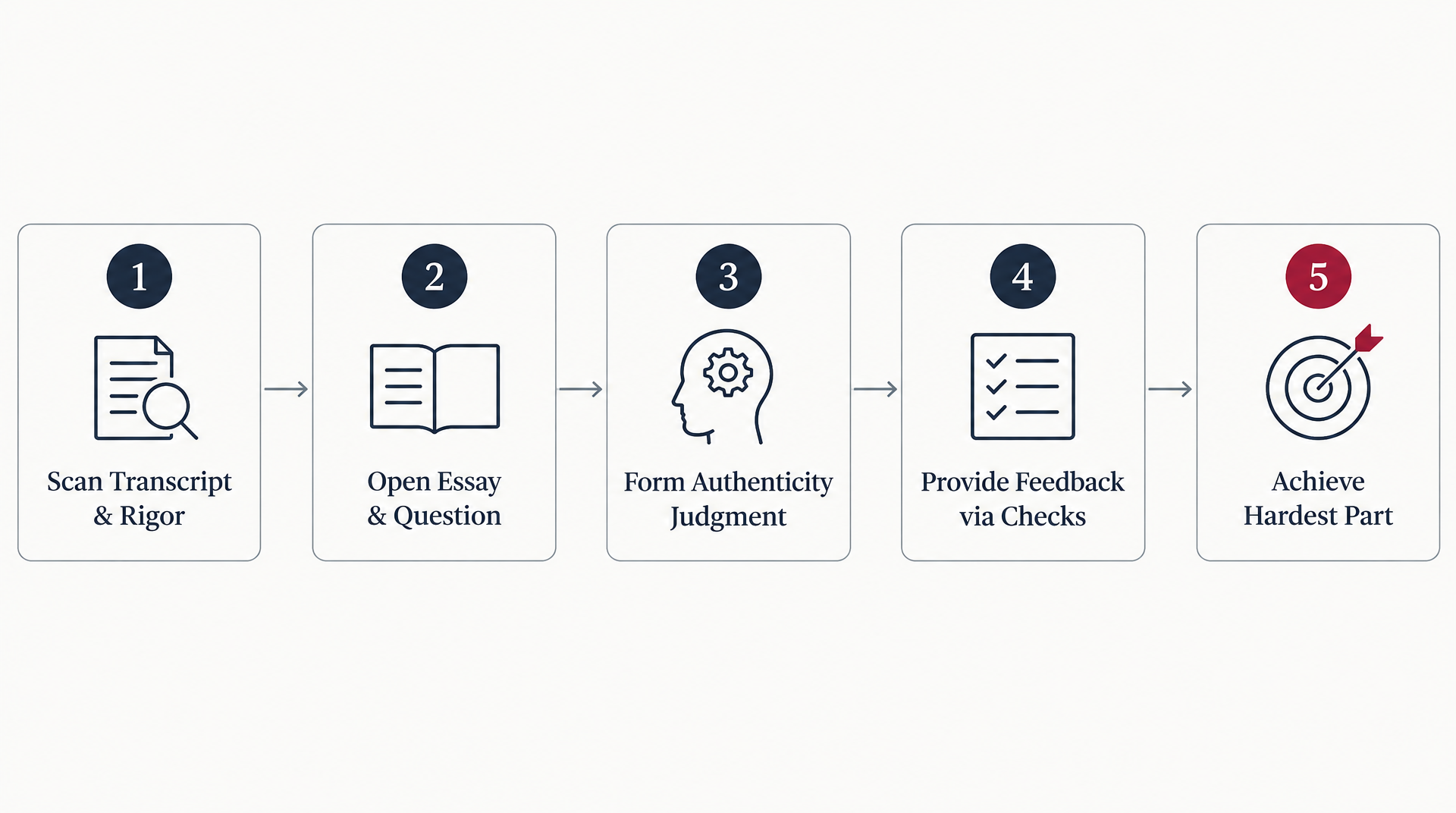
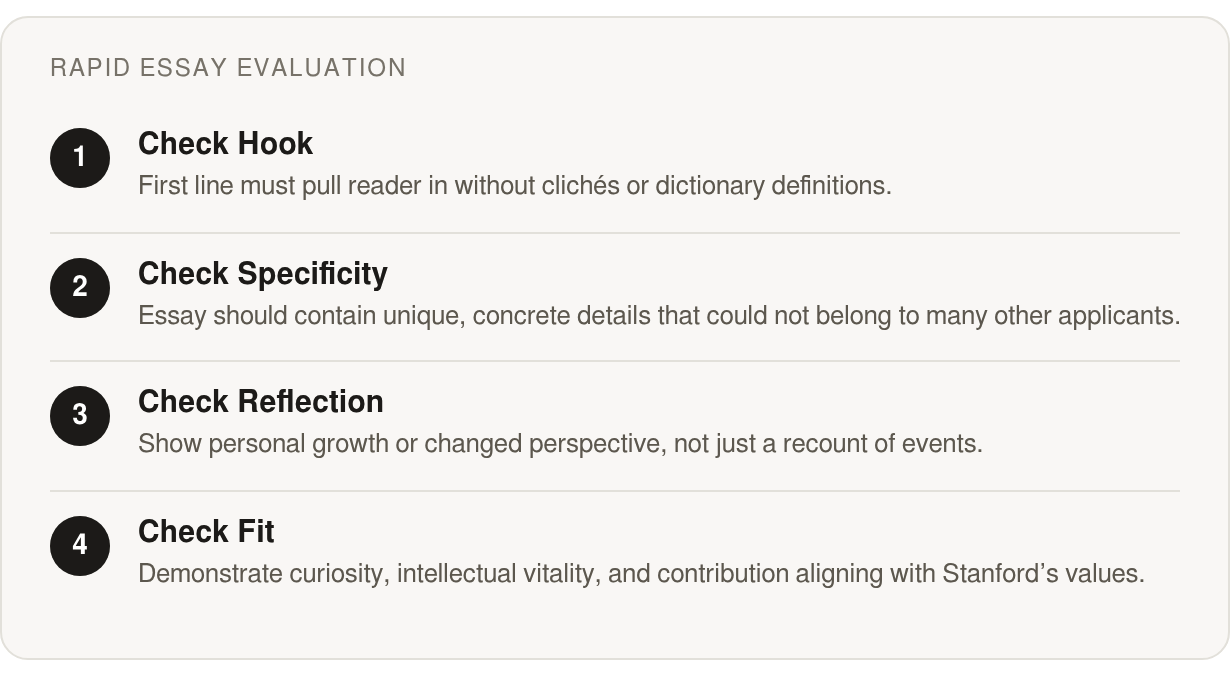
Here's how we teach students to score their own drafts before a reader does. Four fast checks, in order, and you stop the moment one fails.
The Four-Check Scan That Decides Your Essay
Read your own draft against these, timing yourself. If a reader can't answer "yes" in seconds, neither can you.
-
Hook. Does the first line pull a reader in without a quote from a dead philosopher or a dictionary definition? A weak opener burns your best 15 seconds. Start inside a specific moment, not a thesis statement.
-
Specificity. Could this essay belong to anyone else in the pool? Swap your name out. If it still fits ten thousand students, it's generic. Concrete details, the odder the better, are what make a reader lean in.
-
Reflection. Does the essay show how you changed, not just what happened? A story with no growth reads like a résumé in prose. Readers want the thinking, not the event.
-
Fit. Does your voice line up with what Stanford values: curiosity, intellectual vitality, a sense of contribution? You don't name-drop the school. You show the mindset.
Red Flags That Kill a Draft in 15 Seconds
Some moves trigger an instant downgrade. Clichés like "I learned the value of hard work." Language so safe it says nothing. Big claims with no evidence under them.
Skip the formatting gimmicks too. Bolding your "key moment" or engineering a twist ending won't fool a reader who does this all day. A clean, honest draft beats a manufactured one every time.
Pass all four checks and dodge the red flags, and you've done the hardest part.
Recommendations, Interview Readiness & Cultural Fit Snapshot
The last three components of the 90-second read move fast because they confirm a story the reader has already started building. Recommendations, interview signals, and cultural fit aren't scored on their own. They either back up your one-sentence persona or expose a gap in it.
The pattern we teach students to expect: a reader who has scanned your transcript and essay is now checking one thing across all three. Does the same person show up everywhere? The College Board frames holistic review as a two-part inquiry, your likely success plus what you add to the community. Recommendations and fit are how a reader tests that second half fast.
Recommendations Get Read for Specificity, Not Praise
A recommendation earns credibility through anecdote, not adjectives. The same complaint a former Stanford reader raised about vague essays that say nothing applies to letters. A teacher who writes "hardworking and kind" tells a reader nothing. A teacher who describes the day you rebuilt a failed experiment in front of the class tells them everything.
So when you pick recommenders, choose the ones who witnessed a specific moment, not the ones with the most impressive title. Generic praise is a quiet red flag. It reads as a writer who didn't know you well, which weakens the exact persona your file is trying to prove.
Interview and Activity Depth Test Consistency
Stanford builds a class around students with genuine talent in a focused area. That's why a scattered activity list backfires. The former reader flags that a resume of "join this club, try that leadership, build an app, do a science fair" doesn't work and won't advance to committee.
The activity section should make your center of gravity obvious. Leadership matters, but ownership matters more: what did you build, repair, organize, research, teach, or sustain when no one handed you a script? In an interview, that depth shows up as fluency. Students who have lived the work can explain the problem, the tradeoffs, and the next question without sounding rehearsed.
Cultural Fit Is Whether You Match the Ethos
Stanford's holistic review, and its roughly three-and-a-half-percent admit rate, means fit is a real filter, not a slogan. Readers are pattern-matching for independent, interdisciplinary, impact-driven students. Your file should show you starting something, connecting fields, and moving past your own benefit.
This is where the highest-value tweak lives. Don't add accomplishments to signal fit. Reframe one genuine effort so the impact on other people is visible. That single edit often does more than a new line on the activity table, because it gives the reader a reason to believe your work mattered beyond you.
Turning the Verdict Into Your Next Move
Ninety seconds of reading has to end in one sentence you can act on. That's the whole point. We compress our read into clear, prioritized guidance so you know the single lever that moves your odds most. Feedback without a next move is just a grade, and grades don't get anyone into Stanford.
This is where our work splits from a one-time critique. The read is the diagnosis. The plan behind it is the treatment. In our experience, the students who improve are the ones who leave with prioritized fixes, a timeline, and regular check-ins to stay on track.
How do you turn feedback into a roadmap?
We rank fixes by impact, not by how easy they are. If the essay reads generic, that jumps to the top even though it's the hardest to solve, because voice is the lever a reader weighs most. A missing leadership signal or a thin activity list gets its own milestone with a deadline weeks out, not days.
Then we review the changes together at the next check-in. Through regular feedback sessions, we see whether the fix worked. If it didn't, we were wrong about the lever, and we say so, then re-prioritize.
How does our two-phase model work?
Our work runs in two phases: life-prep and application-prep. The guidance carries through both, but it does different jobs.
In the life-prep phase, sometimes starting as early as 8th grade, we focus on a student's trajectory, not a finished file. We point to experiences worth building so your resume and activity list say something real years later. The four non-academic signals we look for map closely to what matters in those early years.
In the application-prep phase, check-ins become a regular rhythm. Two team members read every essay, so you get the panel view a single consultant can't offer. As deadlines approach, we shift toward refinement rather than big structural changes. Late-stage overhauls do more harm than good.
References
[1] An interview with a Stanford admissions reader - https://college.7sage.com/blog-posts/an-interview-with-a-stanford-admissions-reader
[2] Holistic Admission : Stanford University - https://admission.stanford.edu/apply/overview/index.html
[3] Is Your Student Stanford Ready? - Top Tier Admissions - https://toptieradmissions.com/is-your-student-stanford-ready/
[4] [PDF] Understanding Holistic Review in Higher Education Admissions - https://highered.collegeboard.org/media/pdf/understanding-holistic-review-he-admissions.pdf
Common Questions
What if my high school offers very few AP or honors courses?
Don't compare your schedule to a school you don't attend. The stronger move is to make sure your transcript, counselor materials, and activity record together show that you used the opportunities available to you seriously. If your school has fewer advanced courses, initiative outside the classroom can also help the reader understand how you stretched.
My freshman-year grades were weak. Will that sink my application?
A rough start is not ideal, but it is not the whole case. What matters is whether the later record shows maturity, harder choices, and a clearer academic direction. If the trend improves, don't over-explain the early stumble in every part of the application; let the stronger recent evidence carry the point.
Stanford requires the SAT or ACT again, so should I submit a mediocre score?
Because testing is required again, the question is not whether to hide the score; it is how to keep it in proportion. A weaker result needs the rest of the academic file to be especially clear: demanding courses, strong grades, and recommendations that confirm classroom strength. Don't let test anxiety push you into neglecting the pieces that still shape the broader read.
How do I know if an activity has enough depth to matter?
Look for evidence of ownership. Did your role become more demanding over time? Did you solve a real problem, mentor others, produce something concrete, or change how the group operated? If the activity description only lists membership and meeting attendance, it probably needs either sharper framing or less space.
Is it worth overhauling my essay right before the deadline?
Only if the current draft has a fundamental problem, such as no clear subject, no reflection, or a voice that sounds nothing like you. Otherwise, late work should focus on tightening the opening, cutting vague claims, and making the ending land. The closer you are to submission, the more dangerous it becomes to trade a stable draft for an untested one.